What Is an Artesian Well?
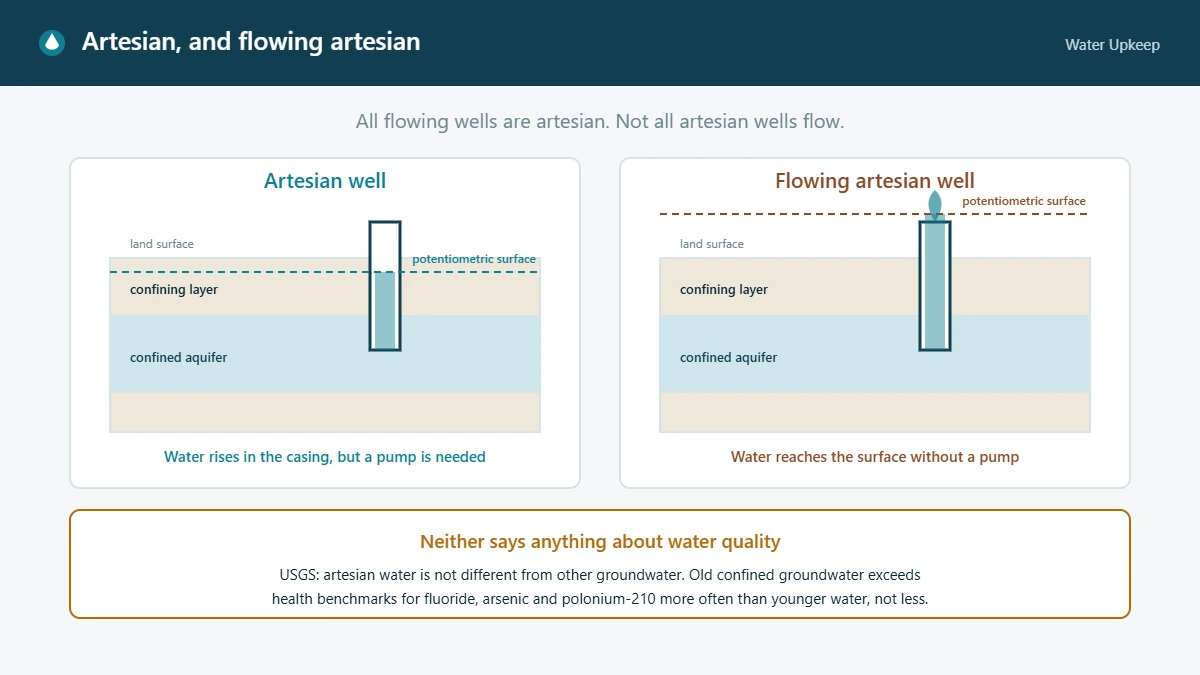
An artesian well is a well drilled into a confined aquifer — one squeezed between two layers of low-permeability rock or clay — where the water is under enough pressure that it rises in the borehole above the top of the aquifer. That is the entire definition. It describes a pressure condition, not a quality. The US Geological Survey puts it flatly: artesian water is really not different from other groundwater, except that pressure in the rocks underground forces it upward. The word appears on bottled water labels because it sounds like a promise. It is not one.
The hydrogeology
USGS describes confined aquifers — sometimes known as artesian aquifers — as aquifers where water is confined under pressure by a geological body much less permeable than the aquifer itself. Because layers of impermeable material sit both above and below, the water is pressurised, so when a well penetrates it the water rises above the top of the aquifer.
How far it rises has a name. The level to which water will rise in tightly cased wells in artesian aquifers is the potentiometric surface — an imaginary surface representing the potential height to which water will rise in wells completed in that confined aquifer. Where that surface sits relative to your land is the whole story of what your well does.
Washington State’s well construction code gives the regulatory version of the same idea: an artesian well is one tapping an aquifer bounded above and below by confining or impermeable rock or soil layers, in which the water will rise above the point of initial penetration.
Artesian is not the same as flowing
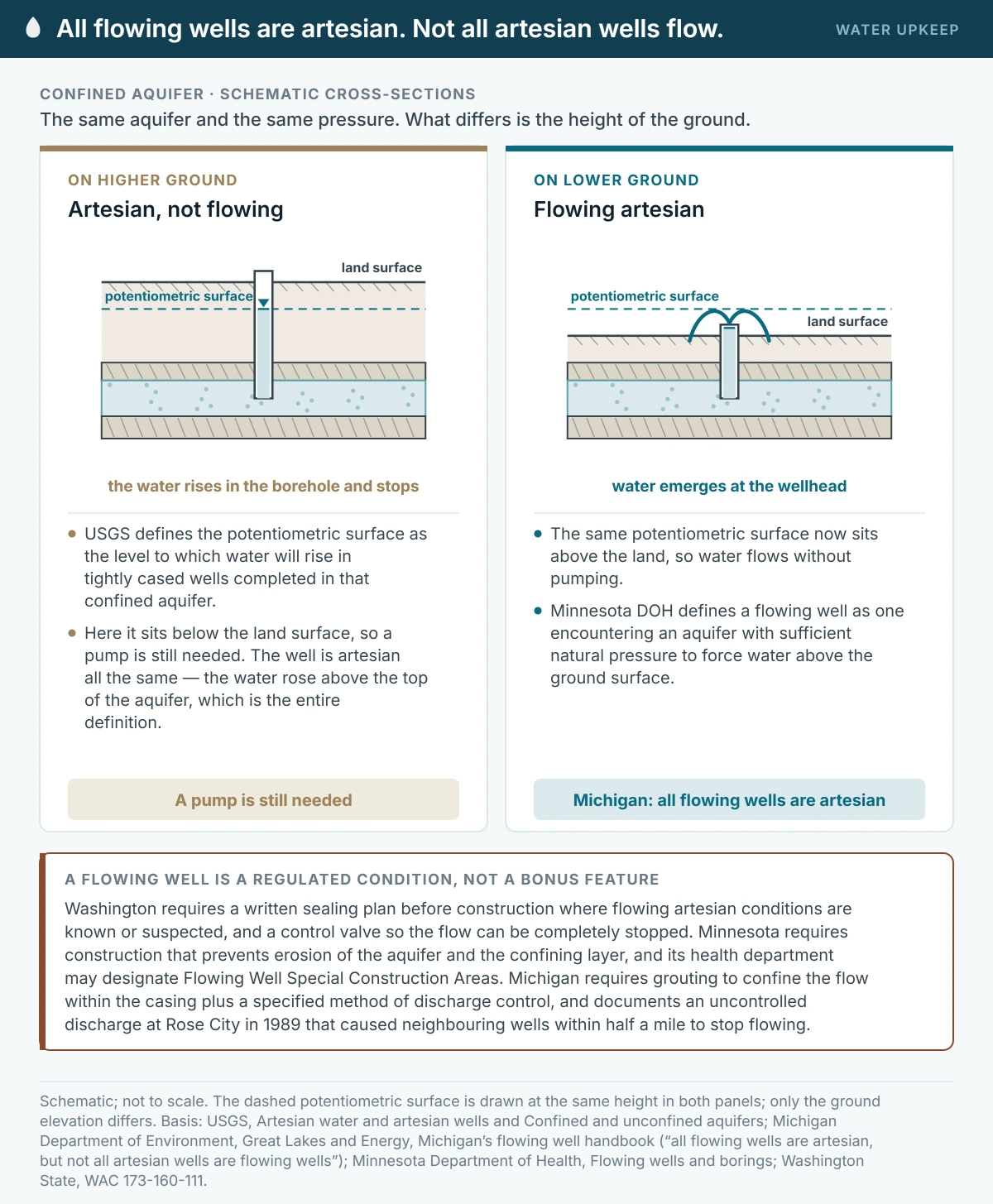
This is where almost everyone, including some water-industry glossaries, goes wrong. Michigan’s Department of Environment, Great Lakes and Energy resolves it in one sentence: all flowing wells are artesian, but not all artesian wells are flowing wells.
An artesian well only needs the water to rise above the top of the aquifer. A flowing artesian well is the special case where the potentiometric surface is above the land surface itself, so water emerges at the wellhead with no pump needed. Minnesota Department of Health defines flowing wells as drilled holes that encounter an aquifer with sufficient natural pressure to force water above the ground surface, so that water will flow without pumping.
Michigan adds a nuance worth knowing: surface flow can be geologically controlled, where a recharge area at higher elevation pressurises a confined aquifer beneath a confining layer, or topographically controlled, where deep flow paths in an unconfined aquifer carry head above the land surface. Not every flowing well is a textbook confined-aquifer artesian well.
Neither is the same as a spring. FDA defines spring water separately as water derived from an underground formation from which water flows naturally to the surface. Three distinct concepts, routinely merged in marketing copy.
Where the water came from, and when
A confined aquifer is not recharged from directly above — that is what the confining layer prevents. USGS explains that water must seep down from the surface at a distance away and travel somewhat horizontally into the confined aquifer. And it moves slowly: in the Great Plains aquifer system, USGS estimates movement through the confined parts at 10 feet per year or less.
That slowness is the reason artesian water is often very old, and the reason the marketing gets the implication exactly backwards.
What artesian pressure tells you about quality
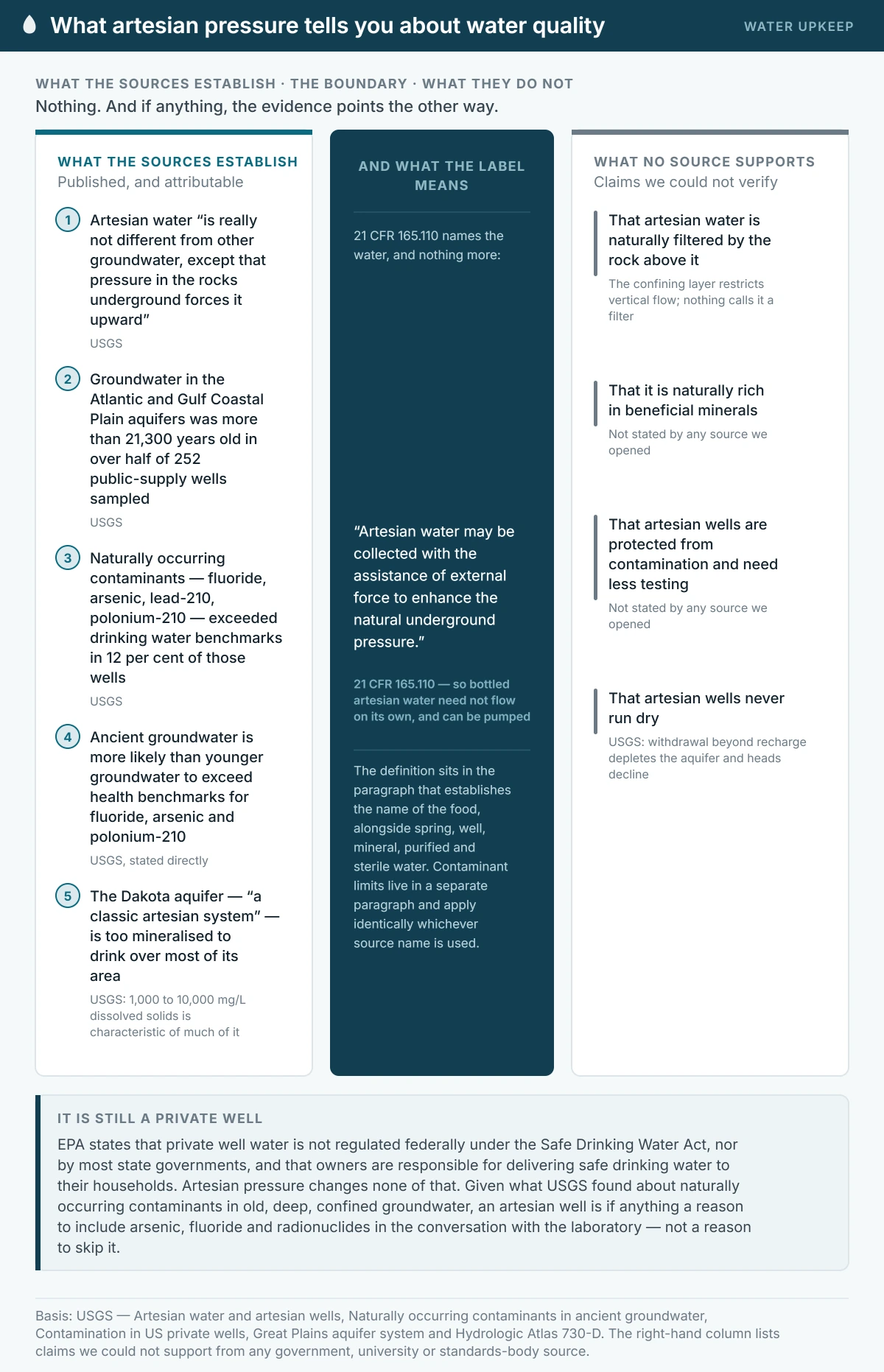
Nothing.
If anything, the evidence points the other way. USGS reports that groundwater in the Atlantic and Gulf Coastal Plain aquifers is old — more than 21,300 years in over half of 252 public-supply wells sampled — and that naturally occurring contaminants including fluoride, arsenic, lead-210 and polonium-210 exceeded drinking water benchmarks in 12 per cent of those wells. Its conclusion is direct: ancient groundwater is more likely to contain concentrations of fluoride, arsenic and polonium-210 that exceed human health benchmarks than is younger groundwater.
The same pattern holds generally. USGS found that about 23 per cent of private wells sampled had one or more contaminants at a level of potential health concern, and that the most frequent ones were mostly from natural geologic sources — radon, arsenic, uranium and manganese coming from the rocks and sediment making up the aquifers.
The best illustration is the most famous artesian system in the country. USGS describes the Dakota aquifer, the uppermost aquifer of the Great Plains system, as “a classic artesian system” — and notes that it contains freshwater only near its southern and eastern margins and in a small area of northwestern Nebraska. Water of 1,000 to 10,000 mg/L dissolved solids is characteristic of much of that system, with sulfate-rich water arising from upward leakage of mineralised water from underlying rocks containing anhydrite and gypsum. Over most of its area, America’s textbook artesian aquifer is too mineralised to drink.
Claims you may have encountered, and which we could not support from any government, university or standards-body source: that artesian water is naturally filtered by the rock above it; that it is naturally rich in beneficial minerals; that artesian wells are protected from contamination and need less testing; that they never run dry. The confining layer restricts vertical flow. Nothing in the sources calls it a filter.
What the bottled water label actually means
21 CFR 165.110 states that the name of water from a well tapping a confined aquifer in which the water level stands at some height above the top of the aquifer is “artesian water” or “artesian well water.” The regulation adds two things that most people would not guess. First, artesian water may be collected with the assistance of external force to enhance the natural underground pressure — so bottled artesian water need not flow on its own, and can be pumped. Second, on request, plants must demonstrate to regulatory officials that the water level stands at some height above the top of the aquifer.
Where that definition sits in the regulation matters as much as what it says. It appears in the paragraph that establishes the name of the food, alongside spring, well, mineral, purified and sterile water. Contaminant limits live in a separate paragraph and apply identically regardless of which source name is used. “Artesian” on a label is a statement about where the water came out of the ground, and nothing else. We cover the rest of that regulation in what filtered water means.
Artesian pressure is finite
USGS states the mechanism simply: when the rate of groundwater withdrawal or discharge exceeds the rate of recharge, the water stored in the aquifer becomes depleted and water levels or hydraulic heads decline.
Las Vegas is the clearest case. Groundwater levels there have declined 300 feet since the first flowing artesian well was drilled in 1907, and those declines have produced as much as 6 feet of land subsidence since 1935, dried up springs, and stopped artesian wells flowing. On the Dakota aquifer, more than 1,000 flowing wells were reported producing from the system in 1905.
Flowing wells are a regulated condition
An uncontrolled flowing well is not a bonus feature. It is something several states require you to be able to shut off.
- Washington requires a written sealing plan before construction where flowing artesian conditions are known or suspected, unperforated casing extending into the confining stratum, and — if the well flows at land surface — a control valve so the flow can be completely stopped.
- Minnesota requires that a well with flows above the ground surface be constructed to prevent erosion of the aquifer and the confining layer, with separate requirements for low flow and pressure (70 gallons per minute or less, 10 psi or less) and high flow and pressure. The health department may designate Flowing Well and Boring Special Construction Areas.
- Michigan requires grouting to protect the artesian aquifer, prevent erosion of overlying materials and confine the flow within the casing, plus a specified method of discharge control, and prohibits unnecessary discharge.
The reasons are practical. Michigan documents an uncontrolled discharge at Rose City in 1989 that caused neighbouring wells within half a mile to stop flowing, with some residents having to install pumps, and notes that erosion of the confining layer and other overlying materials can occur.
It is still a private well
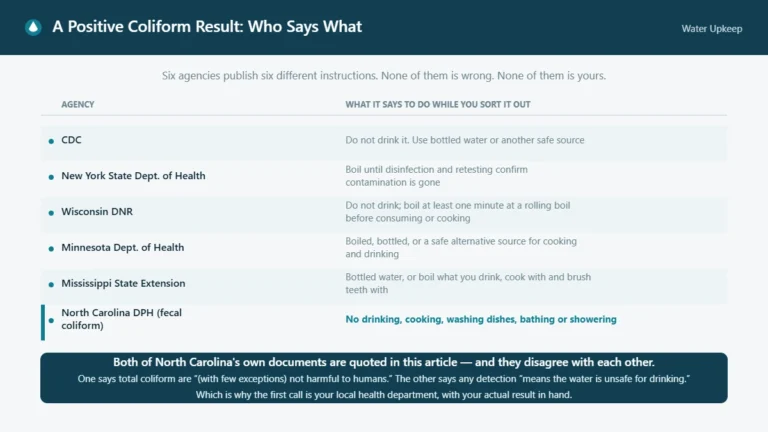
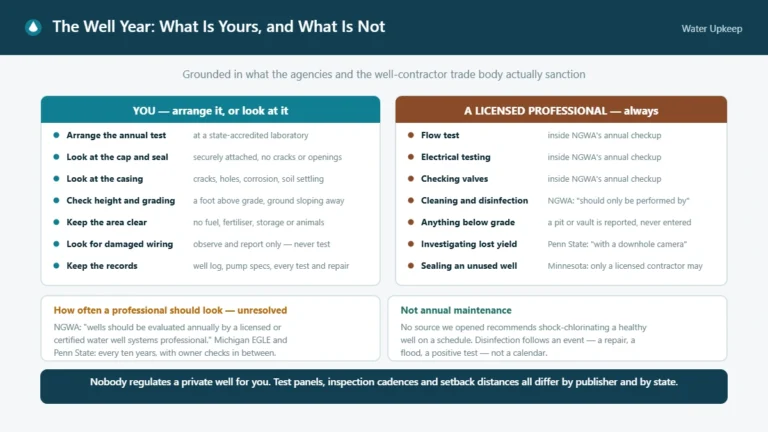
EPA states that the quality and safety of drinking water from private domestic wells are not regulated by the federal government under the Safe Drinking Water Act, nor by most state governments, and that private well owners are responsible for delivering safe drinking water to their households. Artesian pressure changes none of that.
CDC recommends testing well water at least once a year for total coliform bacteria, nitrates, total dissolved solids and pH. Penn State Extension suggests annual coliform testing, pH and total dissolved solids every three years, and a professional inspection at least every ten years. Our guide to how a well works covers the components those inspections look at.
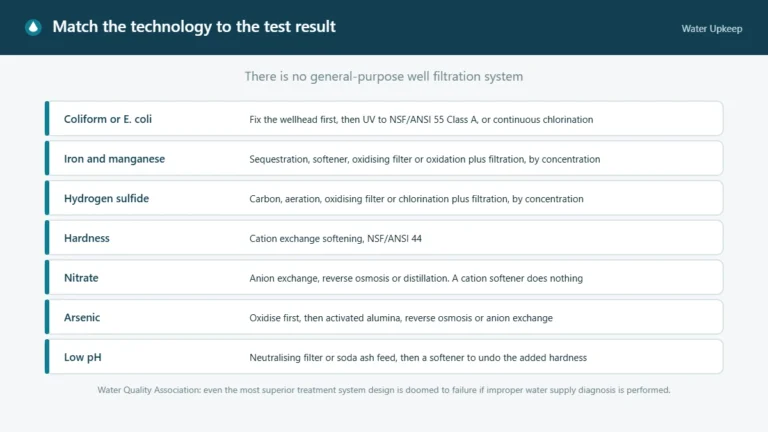
Given what USGS found about naturally occurring contaminants in old, deep, confined groundwater, an artesian well is if anything a reason to include arsenic, fluoride and radionuclides in your testing conversation with the laboratory, not a reason to skip it.
When to call a professional
- Your well flows at the surface and cannot be completely shut off. That is a regulated condition in several states; contact your state well programme.
- You see erosion, settling or persistent wet ground around the casing.
- Flow or pressure has declined noticeably over months or years.
- You have never had the well tested for arsenic, fluoride or radionuclides and it draws from a deep confined aquifer.
- You are buying a property with an artesian or flowing well and have not seen the well record.
More on owning a private supply in our well water hub.
Sources and standards
- US Geological Survey — Artesian water and artesian wells, Confined and unconfined aquifers, Circular 1217, Hydrologic Atlas 730-D, Great Plains aquifer system, Naturally occurring contaminants in ancient groundwater, Contamination in US private wells and Fact Sheet 103-03, groundwater depletion
- eCFR — 21 CFR 165.110, bottled water
- US Food and Drug Administration — Bottled water everywhere: keeping it safe
- Michigan Department of Environment, Great Lakes and Energy — Michigan’s flowing well handbook
- Minnesota Department of Health — Flowing wells and borings
- Washington State Legislature — WAC 173-160-111 and WAC 173-160-251, artesian well sealing standards
- US Environmental Protection Agency — Private drinking water wells
- Centers for Disease Control and Prevention — Guidelines for testing well water
- Penn State Extension — Best management practices for private water wells
Last reviewed September 8, 2026.