What Is Filtered Water?
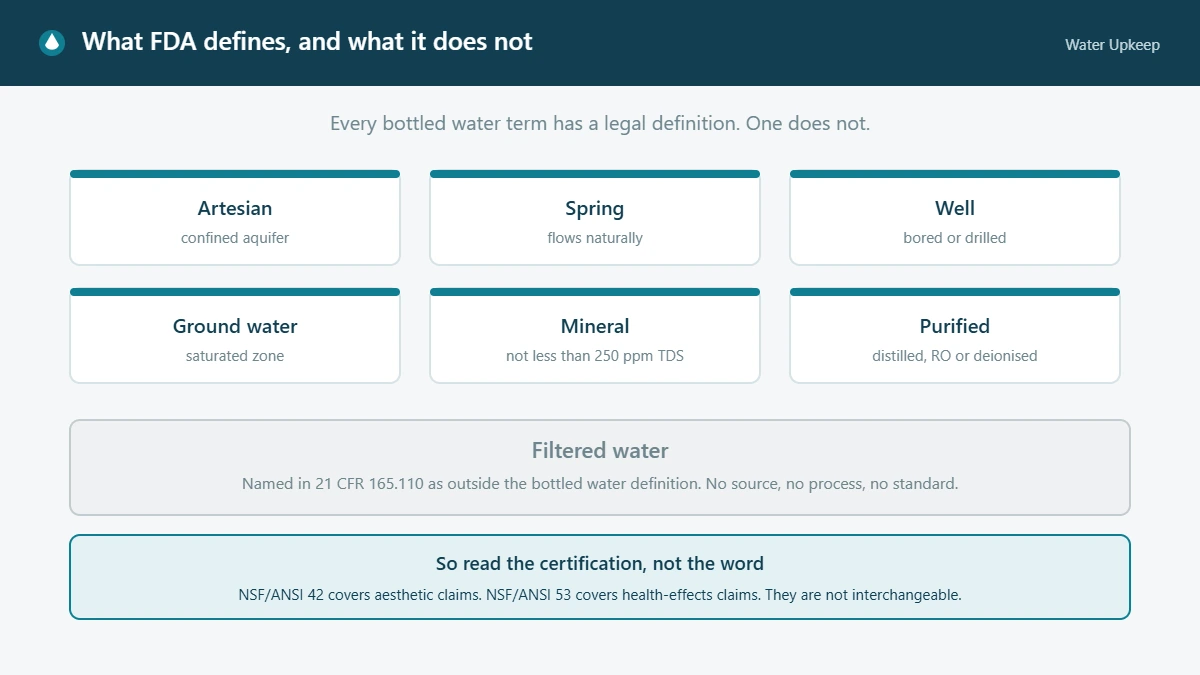
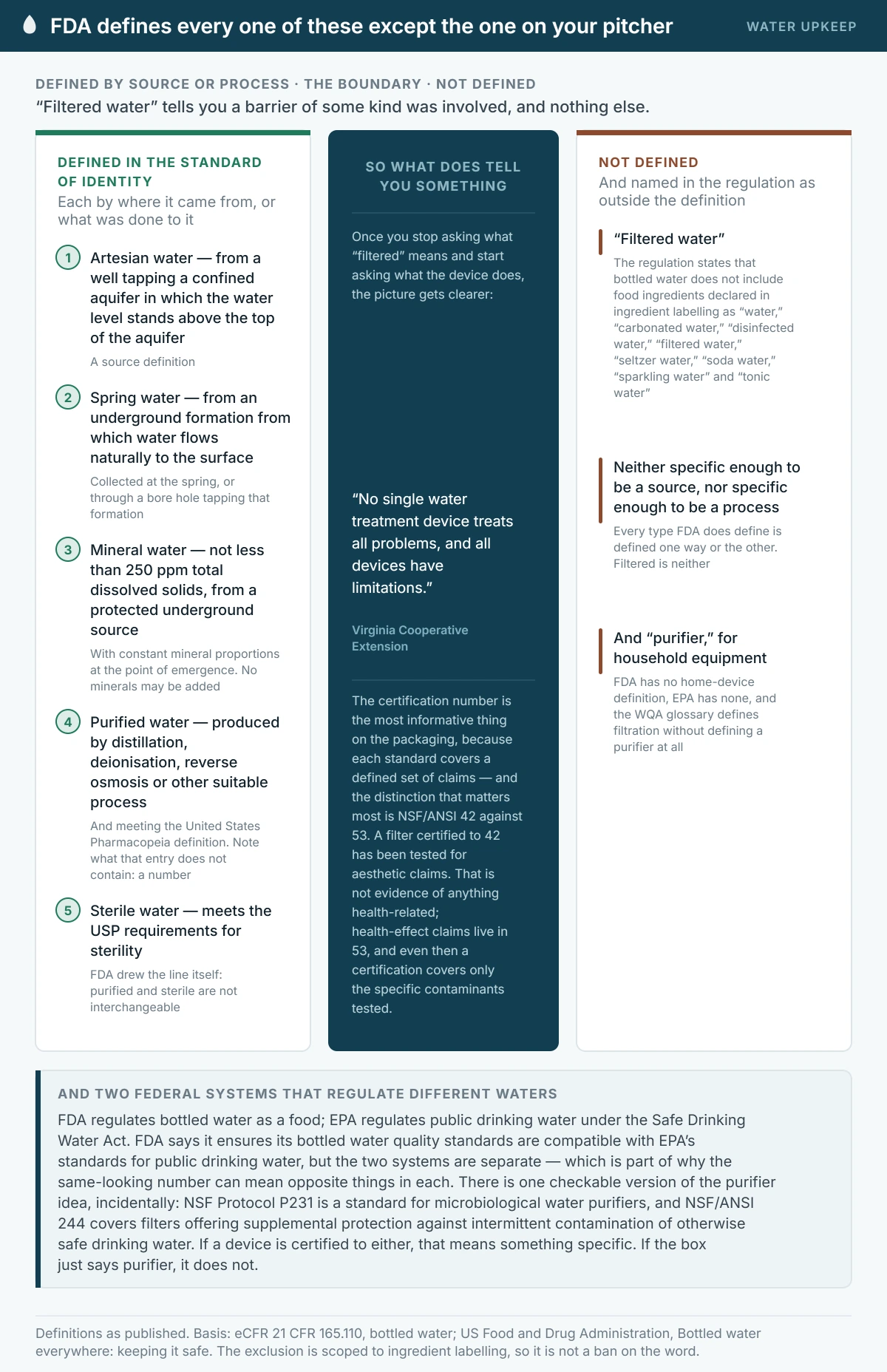
“Filtered water” is not a defined term. Every other phrase on a water label — spring, artesian, mineral, purified, distilled — has a legal definition in FDA’s bottled water standard of identity, with named sources or named processes behind it. Filtered water has none. FDA’s regulation actually lists “filtered water” among the terms that fall outside the bottled water definition entirely. So when a pitcher, a fridge door or a bottle label says filtered, the word tells you a barrier of some kind was involved and nothing else. What matters is which barrier, and what that barrier is certified to remove.
What FDA actually defines
Under 21 CFR 165.110, bottled water is water intended for human consumption, sealed in bottles or other containers, with no added ingredients except optional safe and suitable antimicrobial agents. The regulation then states that this does not include food ingredients declared in ingredient labelling as “water,” “carbonated water,” “disinfected water,” “filtered water,” “seltzer water,” “soda water,” “sparkling water” and “tonic water.”
That exclusion is scoped to ingredient labelling, so it is not a ban on the word. The point for a homeowner is structural: every type FDA does define is defined either by where the water came from or by what was done to it, and “filtered” is neither specific enough to be a source nor specific enough to be a process.
| Term | How FDA defines it |
|---|---|
| Artesian water | From a well tapping a confined aquifer in which the water level stands above the top of the aquifer |
| Spring water | From an underground formation from which water flows naturally to the surface, collected at the spring or through a bore hole tapping that formation |
| Well water | From a hole bored, drilled or otherwise constructed in the ground which taps the water of an aquifer |
| Ground water | From a subsurface saturated zone under pressure at least equal to atmospheric, not under the direct influence of surface water |
| Mineral water | Not less than 250 ppm total dissolved solids, from a protected underground source, with constant mineral proportions at the point of emergence. No minerals may be added |
| Purified water | Produced by distillation, deionisation, reverse osmosis or other suitable process, and meeting the United States Pharmacopeia definition of purified water |
| Sterile water | Meets the USP requirements for sterility |
| Filtered water | Not defined. Named in the regulation as outside the bottled water definition |
Note what the purified water entry does not contain: a number. FDA defines it by process plus conformity to a pharmacopeia standard, not by a parts-per-million ceiling in the regulation itself. Figures you see quoted for purified water do not come from 21 CFR 165.110.
The two numbers people mix up
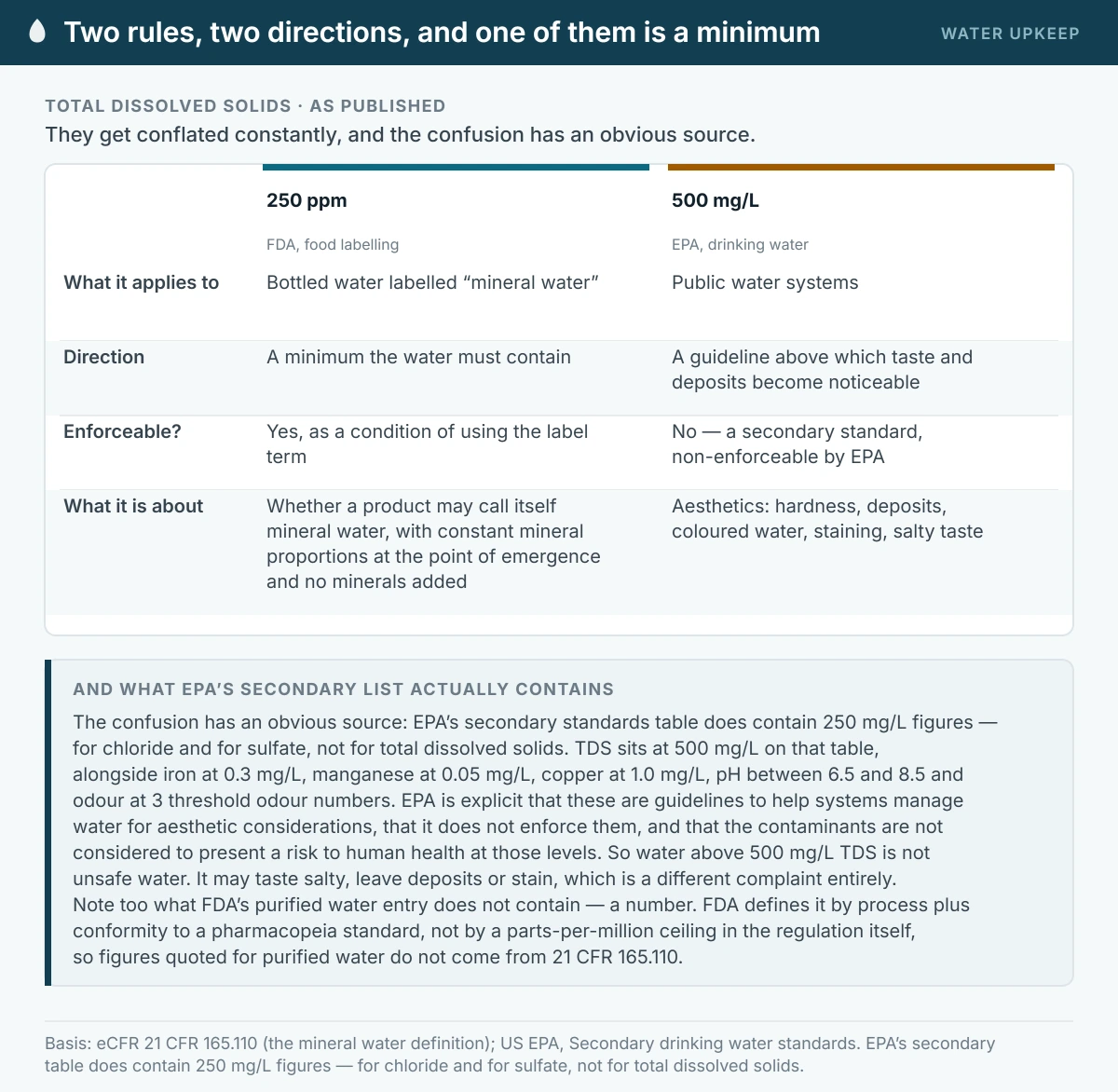
Total dissolved solids appears in two completely different rules, and they get conflated constantly.
| 250 ppm | 500 mg/L | |
|---|---|---|
| Whose rule | FDA, food labelling | EPA, drinking water |
| What it applies to | Bottled water labelled “mineral water” | Public water systems |
| Direction | A minimum the water must contain | A guideline level above which taste and deposits become noticeable |
| Enforceable? | Yes, as a condition of using the label term | No. A secondary standard, non-enforceable by EPA |
The confusion has an obvious source. EPA’s secondary standards table does contain 250 mg/L figures — for chloride and for sulfate, not for total dissolved solids. TDS sits at 500 mg/L on that table, alongside iron at 0.3 mg/L, manganese at 0.05 mg/L, copper at 1.0 mg/L, pH between 6.5 and 8.5 and odour at 3 threshold odour numbers.
EPA is explicit that these secondary standards are guidelines to help systems manage water for aesthetic considerations, that it does not enforce them, and that the contaminants are not considered to present a risk to human health at those levels. Water above 500 mg/L TDS is not unsafe water. It may taste salty, leave deposits or stain, which is a different complaint entirely.
What each kind of filter actually does
Once you stop asking what “filtered” means and start asking what the device does, the picture gets much clearer. CDC and Virginia Cooperative Extension both publish plain summaries, and they agree closely.
| Technology | What it addresses | What it does not |
|---|---|---|
| Activated carbon | Taste, odour, colour, chlorine and chloramine, disinfection byproducts, chlorinated solvents, pesticides, radon | Bacteria, nitrate. Highly water-soluble low-molecular-weight compounds such as methanol are not removed |
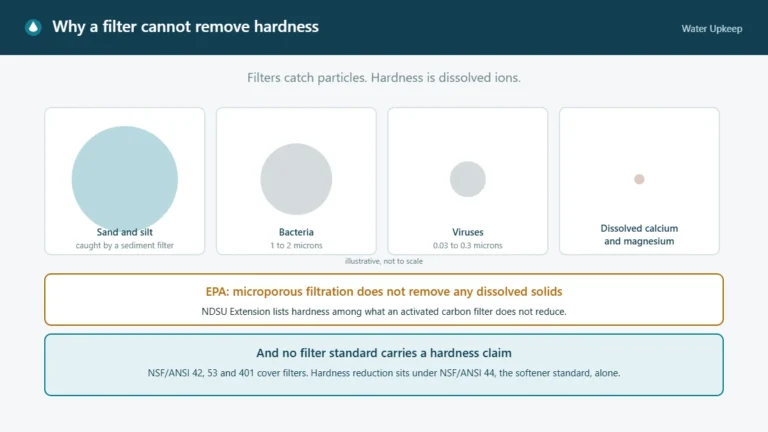
| Mechanical or sediment filtration | Suspended particles — sand, silt, clay, oxidised iron and manganese | Anything dissolved |
| Reverse osmosis | Most dissolved and suspended inorganics, including lead, copper, chromium, chloride and sodium; can reduce arsenic and fluoride | Should not be relied on alone for microbiological safety |
| Ion exchange (softening) | Dissolved calcium and magnesium, small amounts of iron and manganese | Germs, and most other contaminants |
| Distillation | Parasites, bacteria, viruses, metals, minerals and many chemicals | Some volatile organic compounds carry over with the steam |
| Ultraviolet | With adequate pre-filtration, inactivates parasites, bacteria and viruses | Removes no chemicals at all |
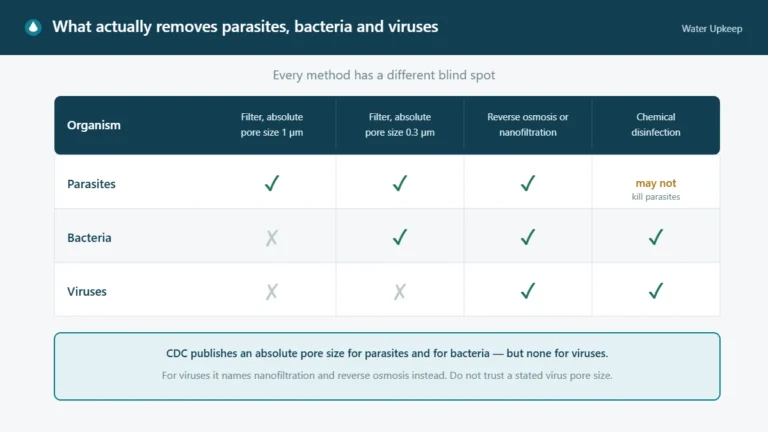
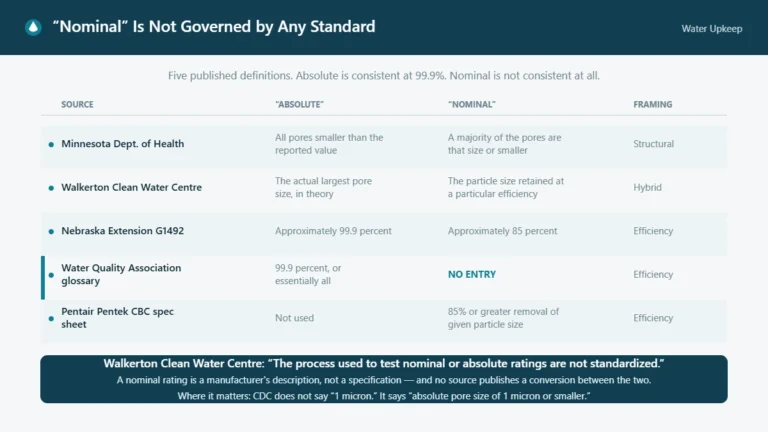
Pore size is what decides a mechanical filter’s reach. CDC puts it in steps: an absolute one-micron filter removes parasites such as Cryptosporidium and Giardia but not bacteria or viruses; absolute 0.3 micron adds bacteria such as E. coli and Salmonella but still not viruses; nanofiltration reaches all three.
The carbon line is the one most homeowners need. CDC states that the main purpose of carbon-based pitcher and fridge filters is to improve the taste and smell of water rather than its safety, and that they do not remove germs. The Water Quality Association describes the mechanism: the carbon surface attracts organic compounds and other non-polar contaminants and adsorbs them, held by van der Waals forces. Adsorption is not straining, which is why a carbon filter can be excellent at chlorine taste and useless against nitrate.
Virginia Cooperative Extension puts the general case in one sentence worth remembering: no single water treatment device treats all problems, and all devices have limitations.
Is a purifier different from a filter?
Not in any rule we could find. FDA has no home-device definition of a purifier, EPA has none, and the Water Quality Association’s glossary defines filtration — the removal of suspended solids by passage through a porous medium — without defining a purifier at all. For household equipment, “purifier” is a marketing word.
There is one checkable version of the idea. NSF P231 is a standard for microbiological water purifiers, based on EPA’s 1987 task force report, and NSF/ANSI 244 covers filters offering supplemental microbiological protection against intermittent contamination of otherwise safe drinking water. If a device is certified to either, that means something specific. If the box just says purifier, it does not.
Reading the NSF/ANSI numbers
The certification number on a filter is the most informative thing on the packaging, because each standard covers a defined set of claims.
| Standard | What it covers |
|---|---|
| NSF/ANSI 42 | Aesthetic effects — chlorine, taste and odour, chloramine, particulate, iron, manganese, zinc, total dissolved solids |
| NSF/ANSI 53 | Health effects — over fifty possible reduction claims for regulated contaminants, commonly lead, Cryptosporidium, VOCs and chromium |
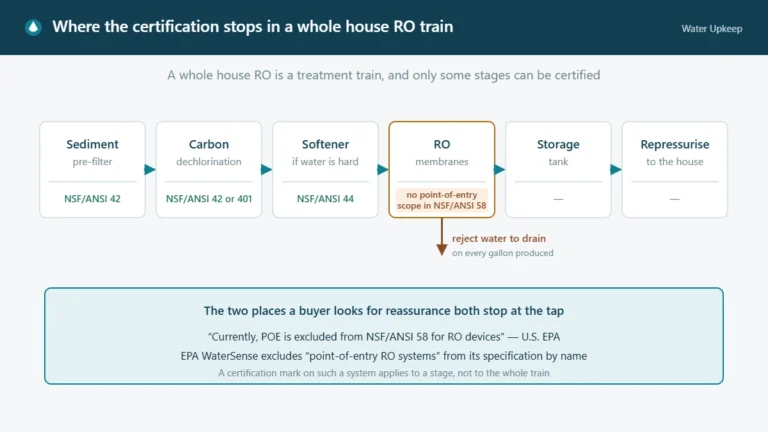
| NSF/ANSI 44 | Cation exchange water softeners |
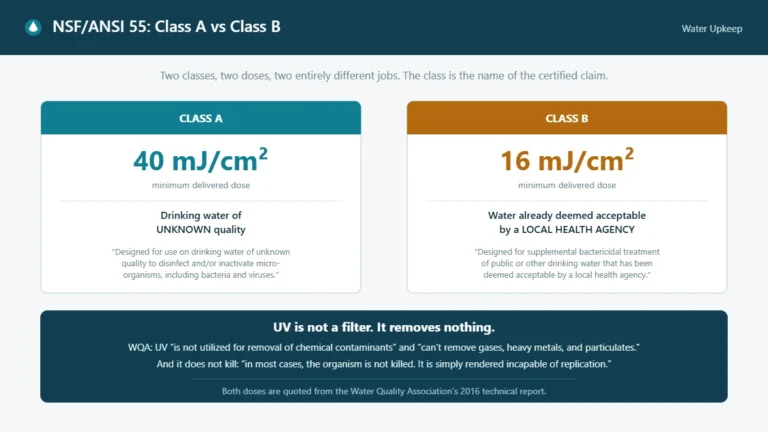
| NSF/ANSI 55 | Ultraviolet systems. Class A inactivates bacteria, viruses and cysts; Class B only reduces non-disease-causing bacteria in already-disinfected water |
| NSF/ANSI 58 | Reverse osmosis systems |
| NSF/ANSI 62 | Distillation systems |
| NSF/ANSI 401 | Emerging compounds — up to fifteen trace contaminants not yet regulated, including pharmaceuticals and pesticides |
| NSF/ANSI 244 | Supplemental microbiological protection on public supplies |
| NSF/ANSI 177 | Shower filters, free available chlorine only |
The distinction that matters most is 42 against 53. A filter certified to 42 has been tested for aesthetic claims — it makes water taste better. That is not evidence of anything health-related. Health-effect claims live in 53, and even then a certification covers only the specific contaminants tested, never the category as a whole.
What filtration does not replace
During a boil water advisory, CDC’s instruction is unambiguous: boil tap water even if it is filtered, including by a home water filter or a filtering pitcher. Boil for one minute, or three minutes above 6,500 feet, then let it cool. Bottled water is the alternative.
Boiling and filtering solve different problems and neither substitutes for the other — a point we cover from the opposite direction in whether boiling removes chlorine.
Point-of-use or point-of-entry
EPA distinguishes the two by what they treat. Point-of-use devices treat only water intended for direct consumption, typically at a single tap or a limited number of taps, usually under the kitchen sink. Point-of-entry devices treat all water entering a home or building. CDC frames the choice practically: if a substance needs removing from all the water in the house rather than only the drinking water, point-of-entry is the answer.
That choice usually follows from what you are trying to fix. Hardness affects every tap, appliance and shower, so it is treated at the entry point — our guide to telling whether you have hard water covers how to establish that first. Taste and odour complaints usually only matter where you drink, and a point-of-use filter is enough.
What to do next
Filtration is the last decision, not the first. Establish what is actually in your water — from your utility’s annual water quality report if you are on a municipal supply, or from a laboratory test if you are on a private well. Then match a technology to the specific finding, and check the device is certified to the standard covering that claim. Buying a filter before knowing what you are filtering is how people end up with a carbon pitcher addressing a nitrate problem.
Note also that FDA and EPA regulate different waters. FDA regulates bottled water as a food; EPA regulates public drinking water under the Safe Drinking Water Act. FDA says it ensures its bottled water quality standards are compatible with EPA’s standards for public drinking water, but the two systems are separate.
More on treating water for the whole house in our whole-house filtration hub.
Sources and standards
- US Food and Drug Administration — 21 CFR 165.110, bottled water and Bottled water everywhere: keeping it safe
- US Environmental Protection Agency — Secondary drinking water standards and Point-of-use and point-of-entry treatment guidance
- Centers for Disease Control and Prevention — Choosing home water filters, Home water treatment systems and Boil water advice
- Virginia Cooperative Extension, Virginia Tech — Household water treatment
- Water Quality Association — Granular activated carbon fact sheet
- NSF — Standards for water treatment systems and NSF/ANSI 42, 53 and 401
Last reviewed September 18, 2026.