What Micron Rating Does Your Water Filter Need?
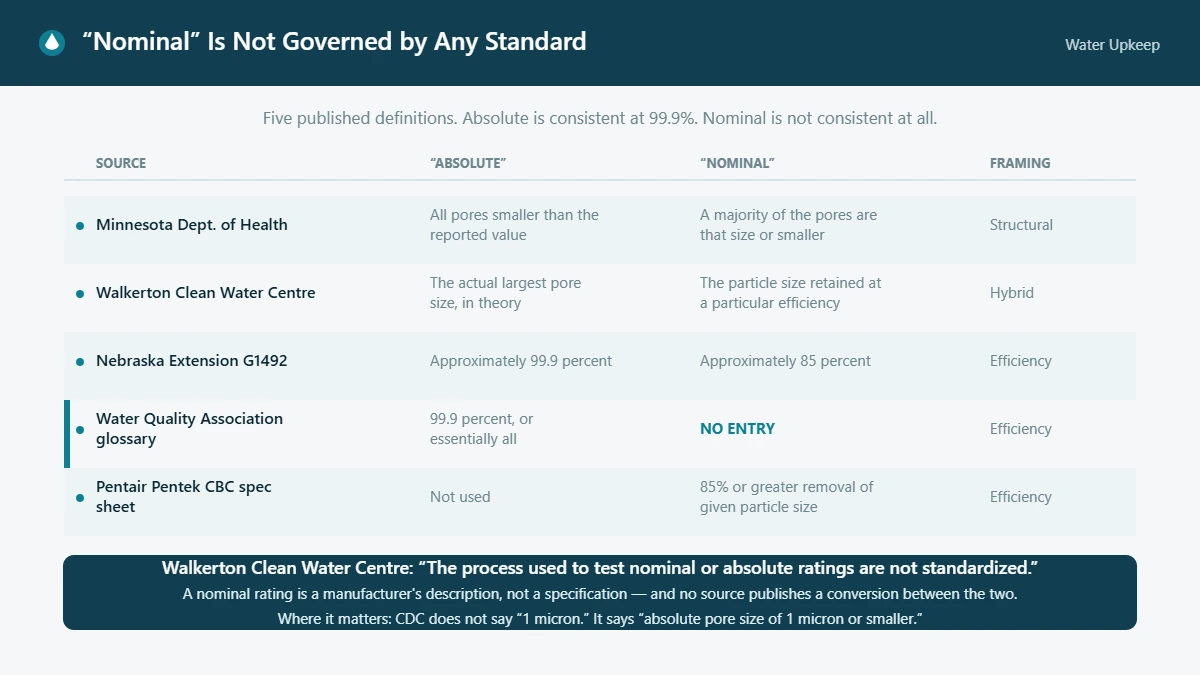
Start with the thing that makes this question hard: the word “nominal” is not governed by any standard. The Walkerton Clean Water Centre, an agency of the Government of Ontario, states it in one line — “the process used to test nominal or absolute ratings are not standardized.” The Water Quality Association’s own glossary defines “absolute filter rating” and has no entry for “nominal filter rating” at all.
So a “5 micron” cartridge from one manufacturer and a “5 micron” cartridge from another are not necessarily comparable, and neither is a specification in the way a reader assumes. What follows is every published definition we could find, what each micron size actually addresses, and what a finer rating costs you.
Nominal and absolute: four definitions that do not agree
| Source | “Absolute” | “Nominal” | Framing |
|---|---|---|---|
| Minnesota Department of Health (writing for noncommunity public water supplies) | “All pores in the filter are smaller than the reported value” | “A majority of the pores are equal in size or smaller than the reported value” | Structural — about pores |
| Walkerton Clean Water Centre (Government of Ontario) | “The actual largest pore size of the filter, in theory” | “The particle size that is retained by the filter at a particular filter efficiency” | Hybrid |
| Nebraska Extension G1492 | “Should trap approximately 99.9 percent” | “Should trap approximately 85 percent of particles equal to the pore size rating” | Efficiency |
| Water Quality Association glossary | “99.9 percent (or essentially all) of the particles larger than a specified micron rating will be trapped on or within the filter” | No entry | Efficiency |
| Pentair, Pentek CBC spec sheet 310078 (manufacturer) | Not used | “Micron ratings based on 85% or greater removal of given particle size” | Efficiency |
Look at what that table shows. Absolute has two consistent numeric definitions at 99.9% — one from a university extension service, one from the industry’s own trade association — plus two structural definitions that say much the same thing. Nominal has no agreed definition at all. Two independent sources put it at 85%; Walkerton’s worked examples illustrate nominal ratings at 99.9% and 99.95%; Minnesota describes it as a majority of the pores; the trade association declines to define it.
Note also that the sources are not even answering the same kind of question. Minnesota’s definitions are about the filter’s construction — how big the holes are. Nebraska’s and Pentair’s are about performance — what fraction of particles get caught. Those are different claims that happen to share a word.
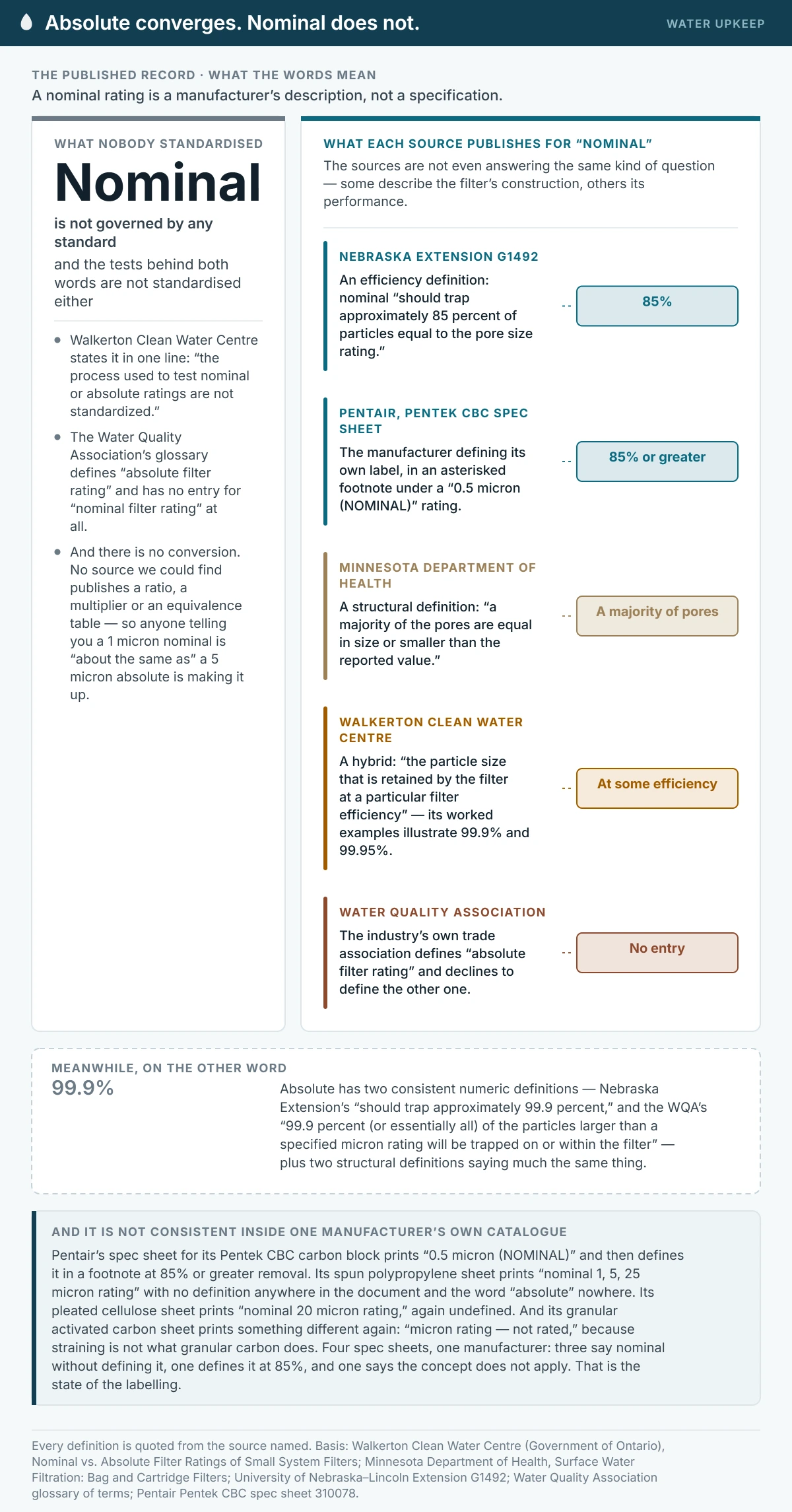
The practical consequence: a nominal rating is a manufacturer’s description, not a specification. And there is no conversion between the two. No source we could find publishes a ratio, a multiplier or an equivalence table, so anyone telling you that a 1 micron nominal is “about the same as” a 5 micron absolute is making it up.
The footnote worth finding on your own cartridge
Pentair’s spec sheet for its Pentek CBC carbon block cartridges prints a micron rating of “0.5 micron” marked “(NOMINAL)” — and then, in an asterisked footnote, tells you what that means: “micron ratings based on 85% or greater removal of given particle size.” That is the manufacturer defining its own label, and it is exactly the kind of disclosure most readers never see.
It is also not consistent across that manufacturer’s own catalog. Its spun polypropylene sheet prints “nominal 1, 5, 25 micron rating” with no definition anywhere in the document, and the word “absolute” does not appear. Its pleated cellulose sheet prints “nominal 20 micron rating,” again undefined. And its granular activated carbon sheet prints something different again: “micron rating — not rated.” A GAC cartridge has no micron rating, because straining is not what it does.
Four spec sheets, one manufacturer: three say nominal without defining it, one defines it at 85%, and one says the concept does not apply. That is the state of the labeling.
What each micron size actually addresses
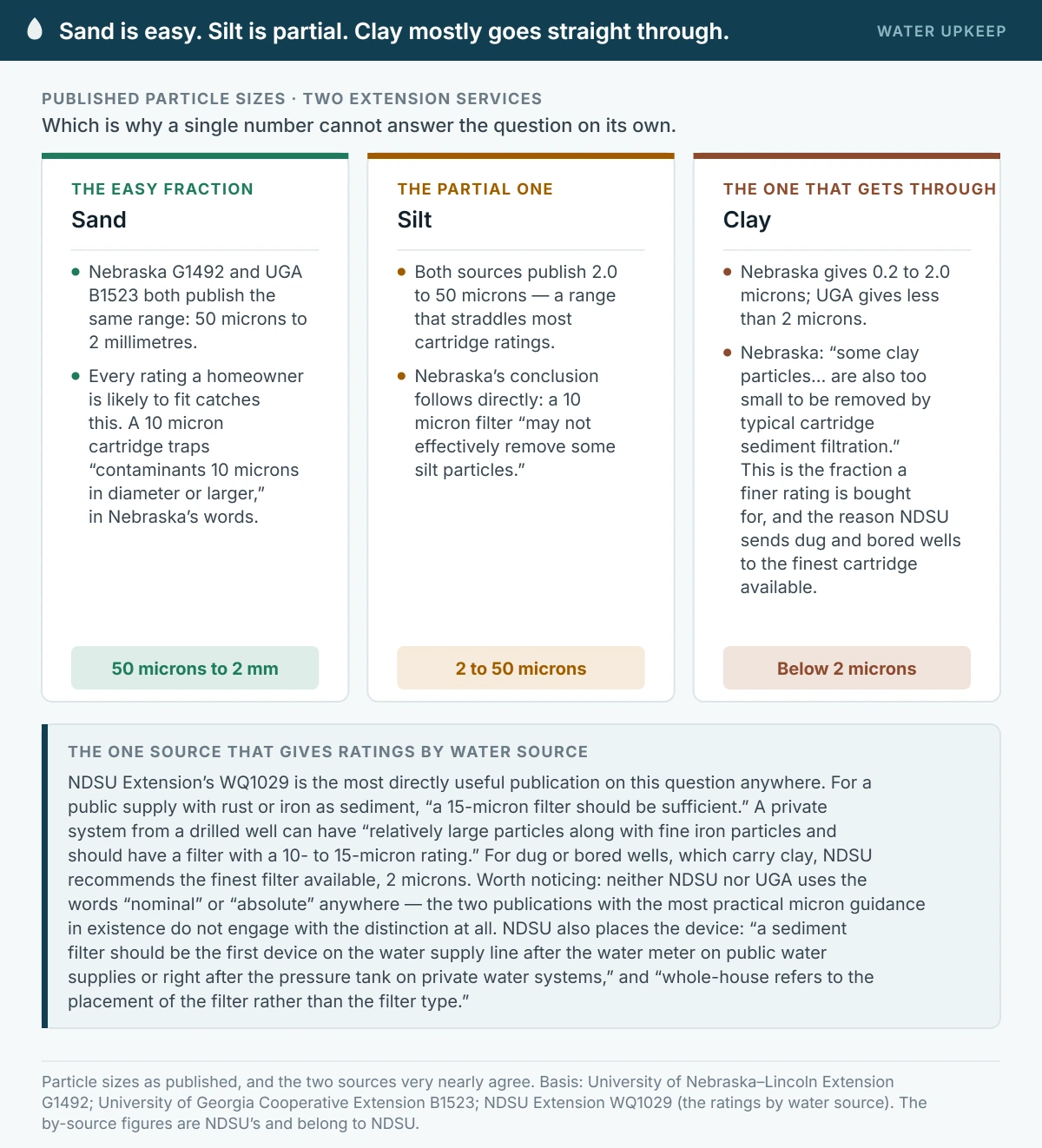
Two extension services publish particle sizes, and they very nearly agree.
| Material | Nebraska Extension G1492 | UGA Extension B1523 |
|---|---|---|
| Sand | 50 microns to 2 millimeters | 50 microns to 2 millimeters |
| Silt | 2.0–50 microns | 2.0–50 microns |
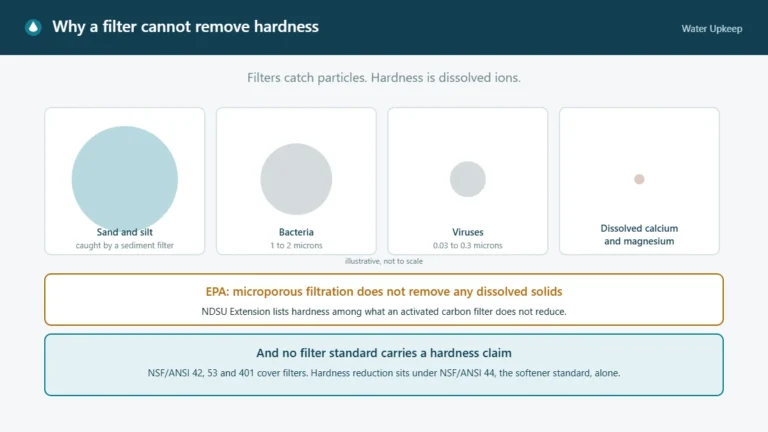
| Clay | 0.2–2.0 microns | Less than 2 microns |
Nebraska’s conclusion follows directly: a 10 micron filter “would trap contaminants 10 microns in diameter or larger,” so it “may not effectively remove some silt particles,” and “some clay particles… are also too small to be removed by typical cartridge sediment filtration.” UGA says the same thing in almost the same words. Sand is easy; silt is partial; clay mostly goes straight through a typical cartridge.
The one source that gives ratings by water source
NDSU Extension’s WQ1029 is the most directly useful publication on this question anywhere, and it is worth quoting exactly.
- Public supply with rust or iron as sediment: “a 15-micron filter should be sufficient.”
- Private system from a drilled well: can have “relatively large particles along with fine iron particles and should have a filter with a 10- to 15-micron rating.”
- Dug or bored wells: NDSU recommends the finest filter available, 2 microns, because these carry clay particles.
- Activated carbon filters “usually are rated by the size of the particles they are able to remove, measured in microns, and generally range from 50 microns (least effective) to 0.5 micron (most effective).”
Worth noticing: neither NDSU nor UGA uses the words “nominal” or “absolute” anywhere. The two publications with the most practical micron guidance in existence do not engage with the distinction at all — which is a fair indication of how much it belongs to manufacturers and regulators rather than to homeowner guidance.
NDSU also places the filter: “a sediment filter should be the first device on the water supply line after the water meter on public water supplies or right after the pressure tank on private water systems,” and “whole-house refers to the placement of the filter rather than the filter type.” Changing one is covered in how to change a whole house water filter.
Where the word “absolute” does all the work
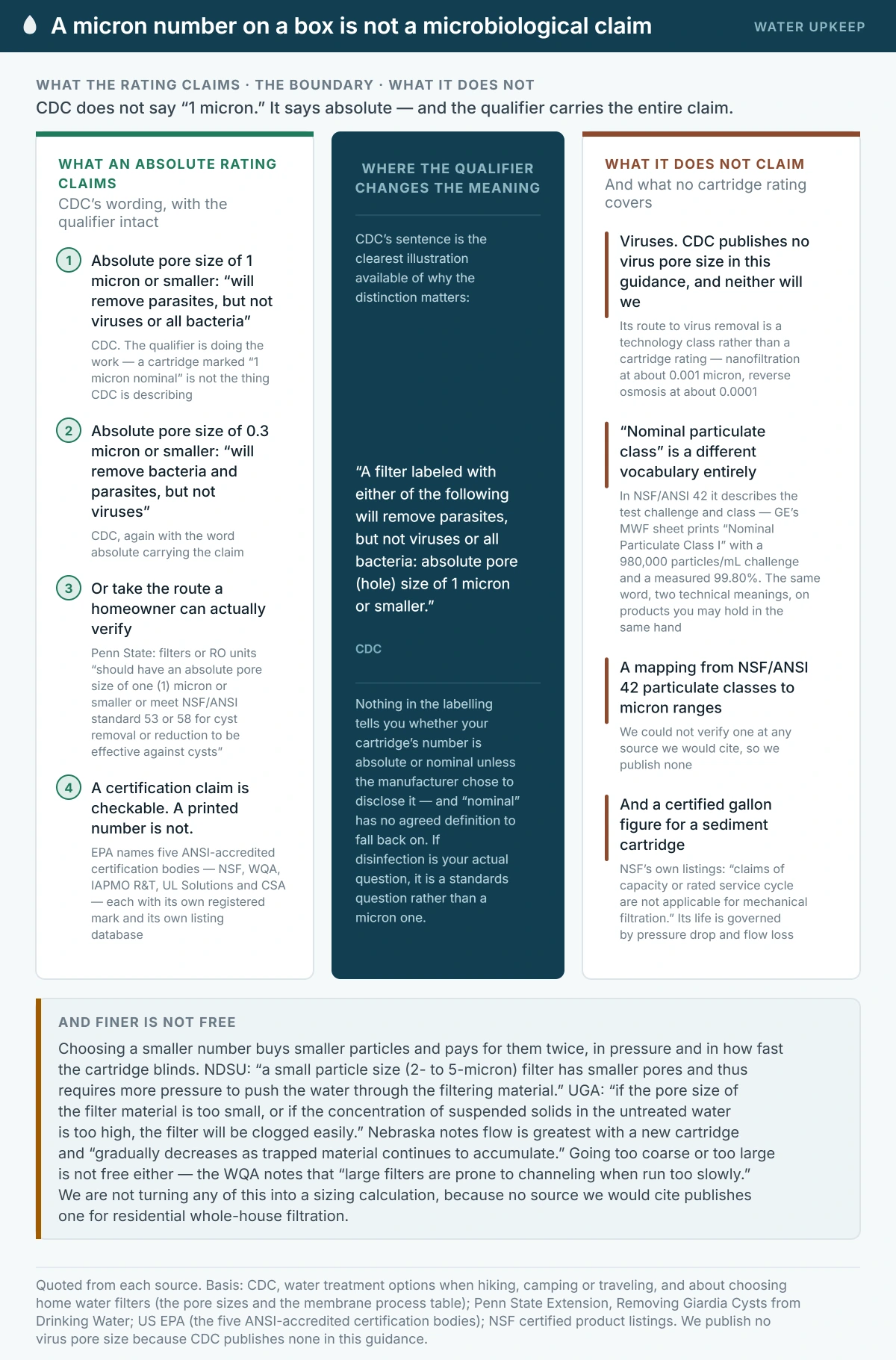
This is why the distinction matters, and CDC’s phrasing is the clearest illustration available. CDC does not say “1 micron.” It says:
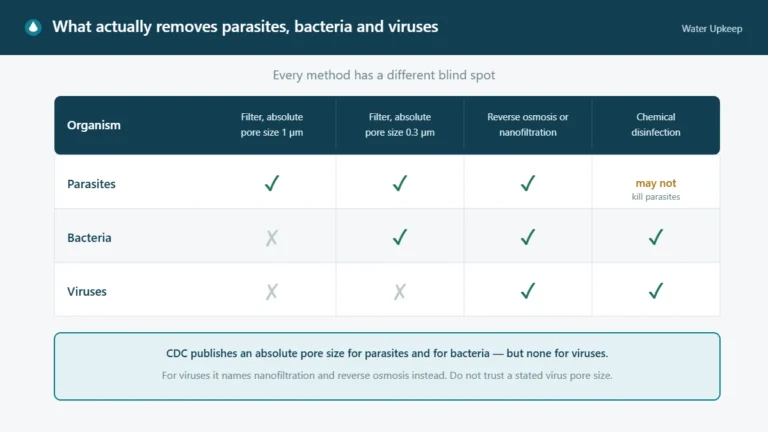
A filter labeled with either of the following will remove parasites, but not viruses or all bacteria: absolute pore (hole) size of 1 micron or smaller… A filter with an absolute pore (hole) size of 0.3 micron or smaller will remove bacteria and parasites, but not viruses.
The qualifier is carrying the entire claim. A cartridge marked “1 micron nominal” is not the thing CDC is describing, and nothing in the labeling tells you the difference unless the manufacturer chose to disclose it.
Penn State adds a second route to the same place, and it is the one a homeowner can actually verify: filters or reverse osmosis units “should have an absolute pore size of one (1) micron or smaller or meet NSF/ANSI standard 53 or 58 for cyst removal or reduction to be effective against cysts.” A certification claim is checkable in the certifier’s own listing database. A printed micron number on a box is not.
Viruses are not a micron question
Note what both CDC figures explicitly exclude: viruses. CDC publishes no virus pore size in this guidance, and neither will we. CDC’s route to virus removal is a technology class, not a cartridge rating — its table of membrane processes gives microfiltration a pore size of about 0.1 micron (removing parasites, somewhat effective against bacteria, removing neither viruses nor chemicals), ultrafiltration about 0.01 micron (parasites and bacteria, limited virus removal), nanofiltration about 0.001 micron (parasites, bacteria and viruses), and reverse osmosis about 0.0001 micron (parasites, bacteria, viruses, plus lead, copper, chromium, chloride and sodium).
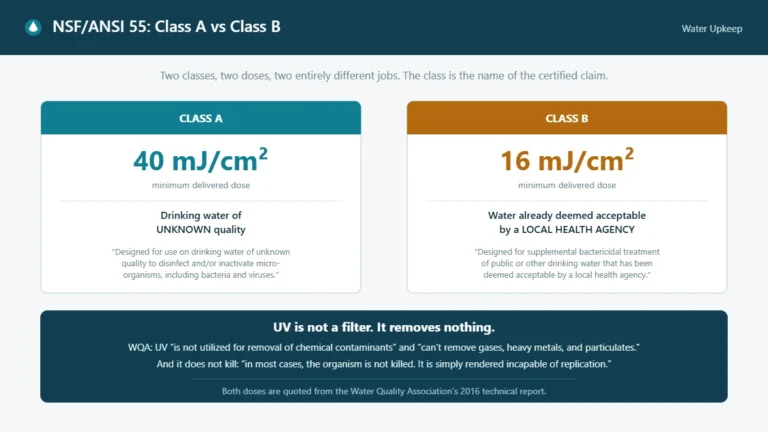
Those are membrane technologies, not cartridge ratings, and they belong in a different conversation from the one on the shelf at the hardware store. If disinfection is your actual question, UV disinfection and NSF/ANSI 55 and what a water purifier is cover the standards that address it — and if you have a positive test result, a positive coliform test on your well and your local health department come first.
Finer is not better
Choosing a smaller number buys smaller particles and pays for them twice: in pressure, and in how fast the cartridge blinds.
- NDSU: “a small particle size (2- to 5-micron) filter has smaller pores and thus requires more pressure to push the water through the filtering material.”
- UGA: “if the pore size of the filter material is too small, or if the concentration of suspended solids in the untreated water is too high, the filter will be clogged easily.”
- Nebraska: flow is greatest with a new cartridge and “gradually decreases as trapped material continues to accumulate.”
Pentair puts numbers on the pressure side within its own catalog. Initial pressure drop is 0.2–0.6 psi for its spun polypropylene cartridges across 2 to 10 gpm; under 1 psi at 10–20 gpm for its gradient-density series; 0.8–2.4 psi at 10 gpm for pleated cellulose; and 3.0–16 psi for granular activated carbon. Those are published figures for named cartridge series at named flow rates — not a sizing method, and not transferable to a different product.
Going too coarse or too large is not free either. WQA notes that “large filters are prone to channeling when run too slowly.” We are not going to turn any of this into a sizing calculation, because no source we would cite publishes one for residential whole-house filtration.
The cartridge is often protecting something else
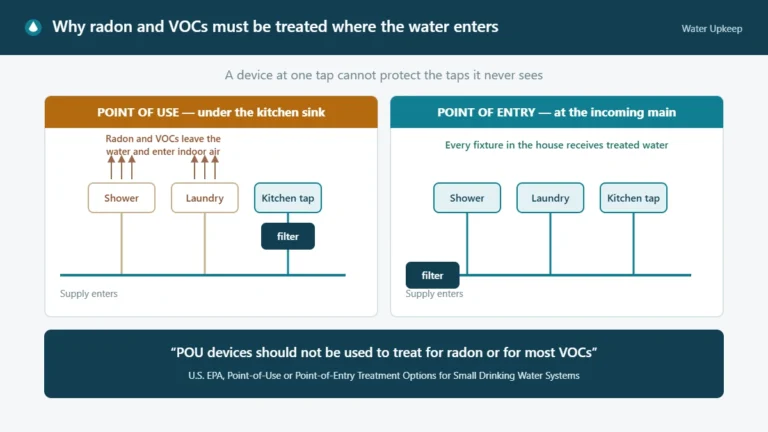
This is why the micron question is rarely a single-number question. EPA, writing for small public water systems: “adsorptive media units should be installed with a particulate pre-filter to remove particles followed by the vessel containing the adsorptive media,” and that pre-filter “is typically used to remove particles and extend the life of GAC cartridges and RO membrane.” Nebraska Extension says the household version: “a sediment or particulate filter installed ahead of any AC filter will prolong the life of the AC filtration unit.” Purdue’s WQ-13 says the same about foam or cotton filters placed ahead of a carbon cartridge.
So the right rating often depends on what sits behind it — a carbon stage, a reverse osmosis membrane, a UV lamp — rather than on the water alone. UV in particular depends on light reaching the organism, which suspended solids prevent; that is covered in UV water disinfection. Servicing an RO stack is reverse osmosis filter replacement.
What a certification does and does not tell you
NSF/ANSI 42 does include a particulate reduction claim, and a certified product’s performance data sheet states a particulate class. GE’s data sheet for its MWF cartridge, for example, prints “Nominal Particulate Class I” with an influent challenge of 980,000 particles per mL, an effluent requirement of at least 10,000 particles per mL, a requirement of at least 85%, and a measured 99.80%.
Careful here: “nominal” in that phrase is NSF/ANSI 42’s particulate-test vocabulary, describing the test challenge and the class. It is not the nominal micron rating this page has been discussing. The same word, two different technical meanings, on products a reader may hold in the same hand.
We could not verify the mapping of NSF/ANSI 42 particulate classes to micron ranges at any source we would cite, so we are not publishing one. What you can do instead is look up a specific product in the certifier’s own listing and read the claims it actually carries. EPA names five ANSI-accredited certification bodies — NSF, WQA, IAPMO R&T, UL Solutions and CSA — each with its own registered certification mark.
One footnote from NSF’s own listings is directly relevant here: “claims of capacity or rated service cycle are not applicable for mechanical filtration.” A sediment cartridge’s life is not governed by a certified gallon figure. It is governed by pressure drop and flow loss, which is why every extension source says to change it when the flow falls off.
Frequently asked questions
What is the difference between nominal and absolute?
Absolute has two consistent numeric definitions at 99.9% removal, from Nebraska Extension and from the Water Quality Association’s glossary. Nominal does not have an agreed definition — 85% from two sources, 99.9–99.95% in Walkerton’s examples, “a majority of the pores” from Minnesota’s health department, and no entry at all in the WQA glossary. And Walkerton states plainly that the test processes behind both are not standardized.
What micron rating do I need?
NDSU Extension is the only source we found that answers this by water source: 15 microns for a public supply with rust or iron sediment, 10 to 15 microns for a drilled well, and the finest available — 2 microns — for a dug or bored well carrying clay. Those are NDSU’s figures. What sits downstream of the cartridge matters too, since a sediment filter is often there to protect a carbon stage, a membrane or a UV lamp.
Is a lower micron number always better?
No. NDSU: smaller pores “require more pressure to push the water through.” UGA: too fine a pore size, or too much suspended solids, and “the filter will be clogged easily.” You trade pressure and cartridge life for particle size.
Can I convert a nominal rating to an absolute one?
No source we could find publishes a conversion — no ratio, no multiplier, no equivalence table. Any such conversion you encounter was invented.
What micron rating removes bacteria or viruses?
For bacteria and parasites, CDC’s figures are an absolute pore size of 0.3 micron or smaller, and 1 micron or smaller for parasites alone. For viruses, CDC publishes no pore size at all — it points to nanofiltration or reverse osmosis as technology classes. Do not treat a cartridge micron number as a microbiological claim.
Why does my carbon filter not have a micron rating?
Because straining is not what it does. Pentair’s granular activated carbon spec sheet prints “micron rating — not rated” outright. Carbon works by adsorption; a carbon block cartridge may carry a micron rating because of how it is constructed, but granular carbon does not.
Sources and standards
- Minnesota Department of Health — Surface Water Filtration: Bag and Cartridge Filters
- Walkerton Clean Water Centre (Government of Ontario) — Nominal vs. Absolute Filter Ratings of Small System Filters
- University of Nebraska–Lincoln Extension — G1492, Sediment Filtration and G1489, Activated Carbon Filtration
- NDSU Extension — WQ1029, Filtration: Sediment, Activated Carbon, and Mixed Media
- University of Georgia Cooperative Extension — B 1523, Mechanical Filtration Methods and Devices
- Purdue Extension — WQ-13, Home Water Treatment Using Activated Carbon
- CDC — water treatment options when hiking, camping or traveling, about choosing home water filters and about home water treatment systems
- Penn State Extension — Removing Giardia Cysts from Drinking Water
- US EPA — Point-of-Use or Point-of-Entry Treatment Options for Small Drinking Water Systems and the consumer tool for identifying certified lead filters
- NSF — NSF/ANSI 42, 53 and 401 filtration systems standards and the certified product listings
- Water Quality Association — glossary of terms and the granular activated carbon fact sheet
- Pentair (manufacturer documentation) — Pentek spec sheets for the CBC series, P series, S1 series, DGD series and GAC series
- GE Appliances (manufacturer documentation) — MWF cartridge data sheet 49-6000321
Last reviewed September 9, 2026.