How to Change a Whole House Water Filter
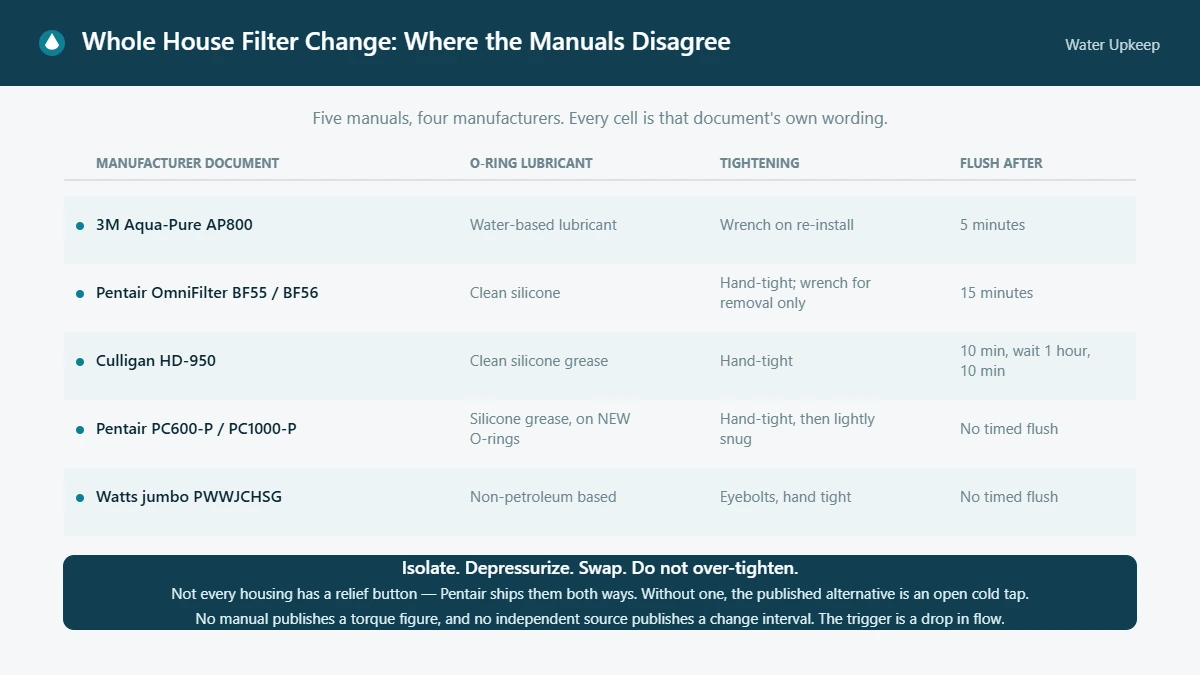
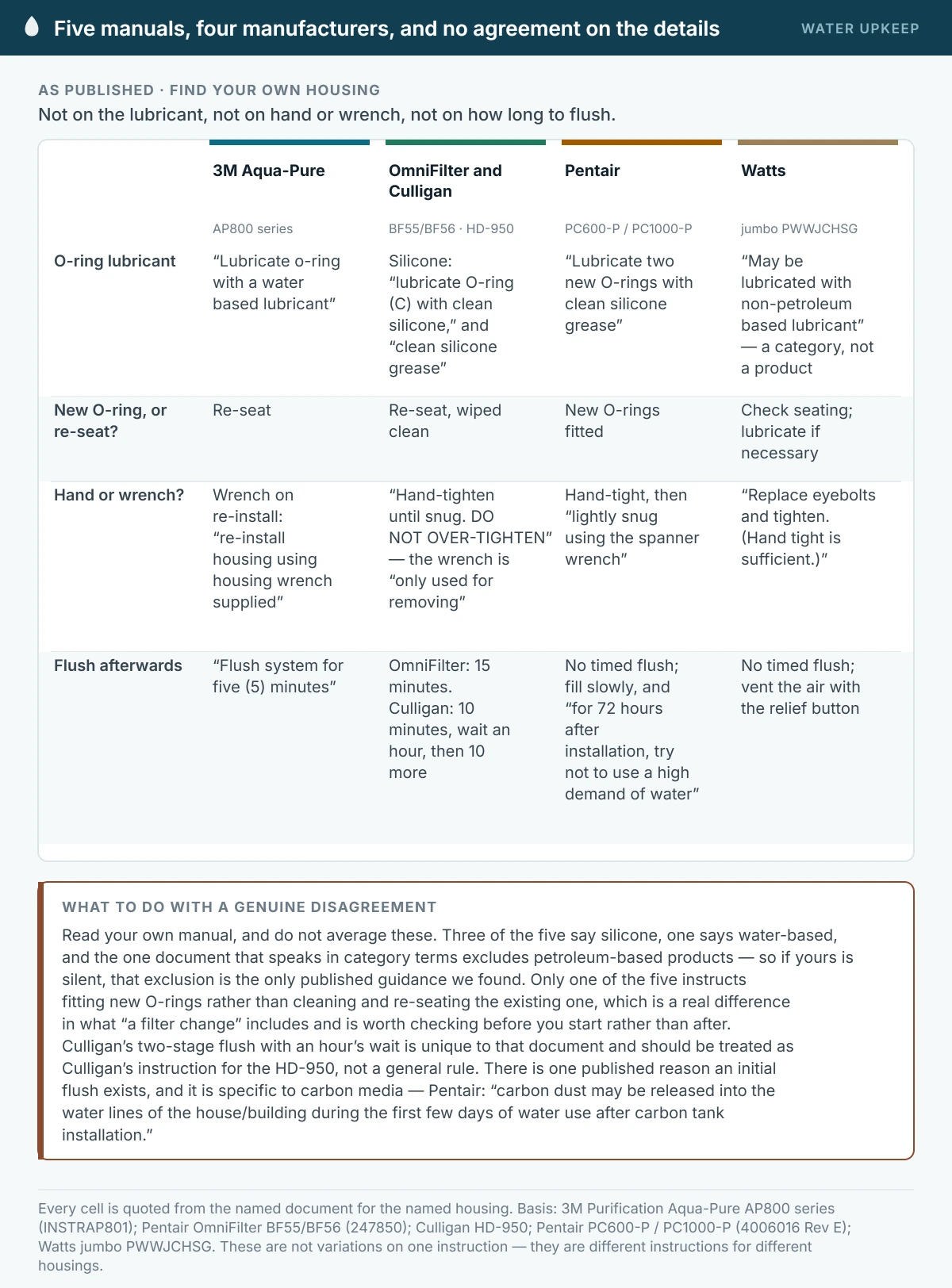
Changing a whole house filter is four moves: isolate the water, let the pressure out, swap the cartridge, and put it back together without over-tightening it. What nobody tells you is that the manufacturers who make these housings do not agree on the details — not on which lubricant goes on the O-ring, not on whether the housing is tightened by hand or with the wrench, not on how long to flush it afterwards. We opened five manuals from four manufacturers and put the disagreements in tables below, so you can find your own housing instead of following a generic set of steps written for someone else’s.
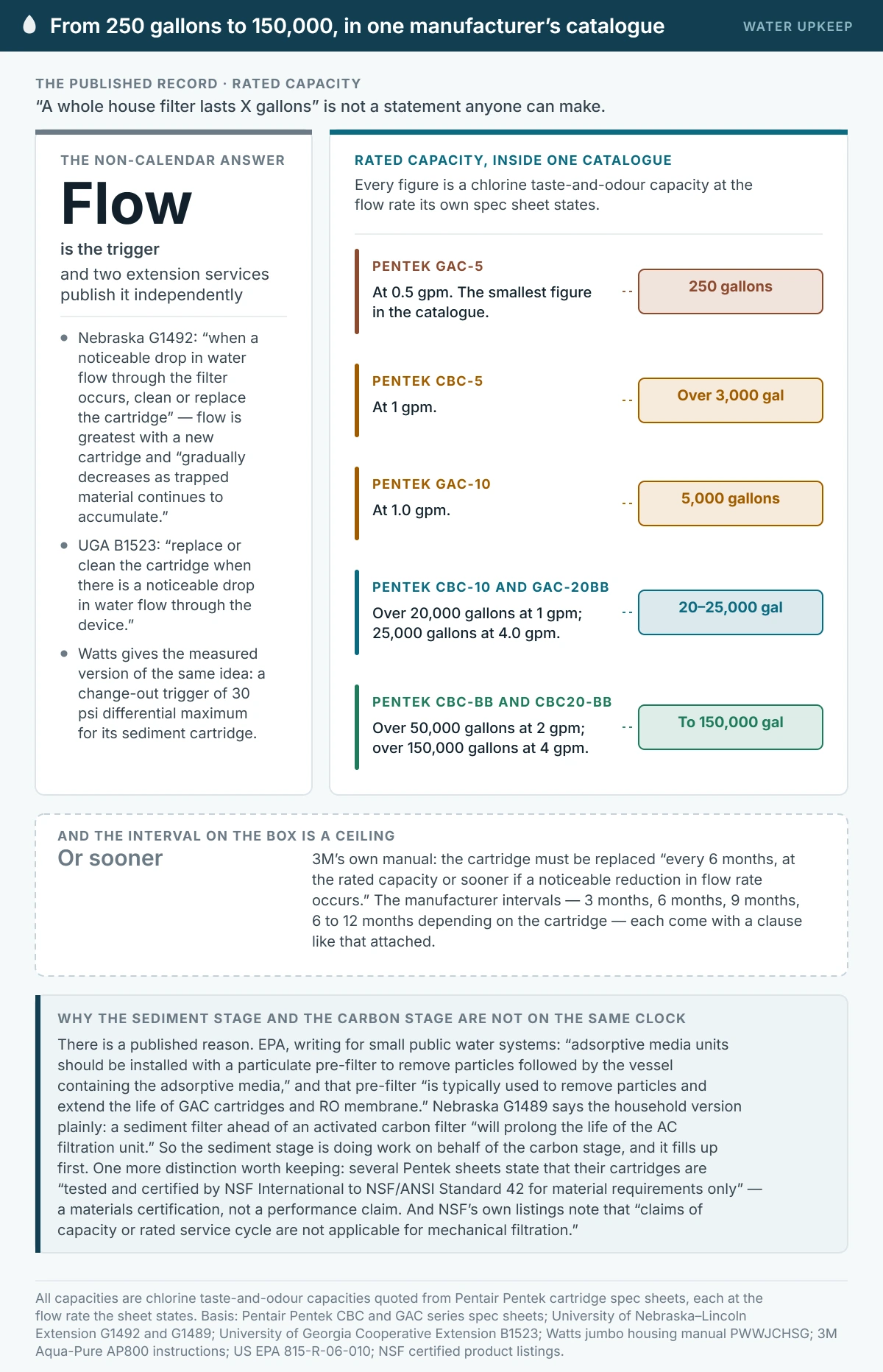
The timing question also has a better answer than a date on a calendar. Two university extension services say the same thing in nearly identical words: replace the cartridge when you notice a drop in water flow. The six-month figure on the box is a ceiling, not a schedule — 3M’s own manual says the cartridge must be replaced “every 6 months, at the rated capacity or sooner if a noticeable reduction in flow rate occurs.”
Before you touch anything: two things that must be true
First, you need a way to shut the water off to the filter. A correctly installed housing has an isolation point — a bypass handle on the filter head, a shut-off valve, or a whole-system bypass on a multi-tank setup. If you do not have one and cannot find one, the job stops here: adding a valve is plumbing work on the incoming main and belongs to a licensed plumber.
Second, you need to know whether your housing has a pressure-relief button. Almost every guide on this subject tells you to press the little red button. Pentair’s own specification sheet for the Big Blue and Big Black housings says they are “available with or without a pressure relief button.” If yours does not have one, pressing a button you do not have is not a plan — see step 2 below for what Pentair’s own manual says to do instead.
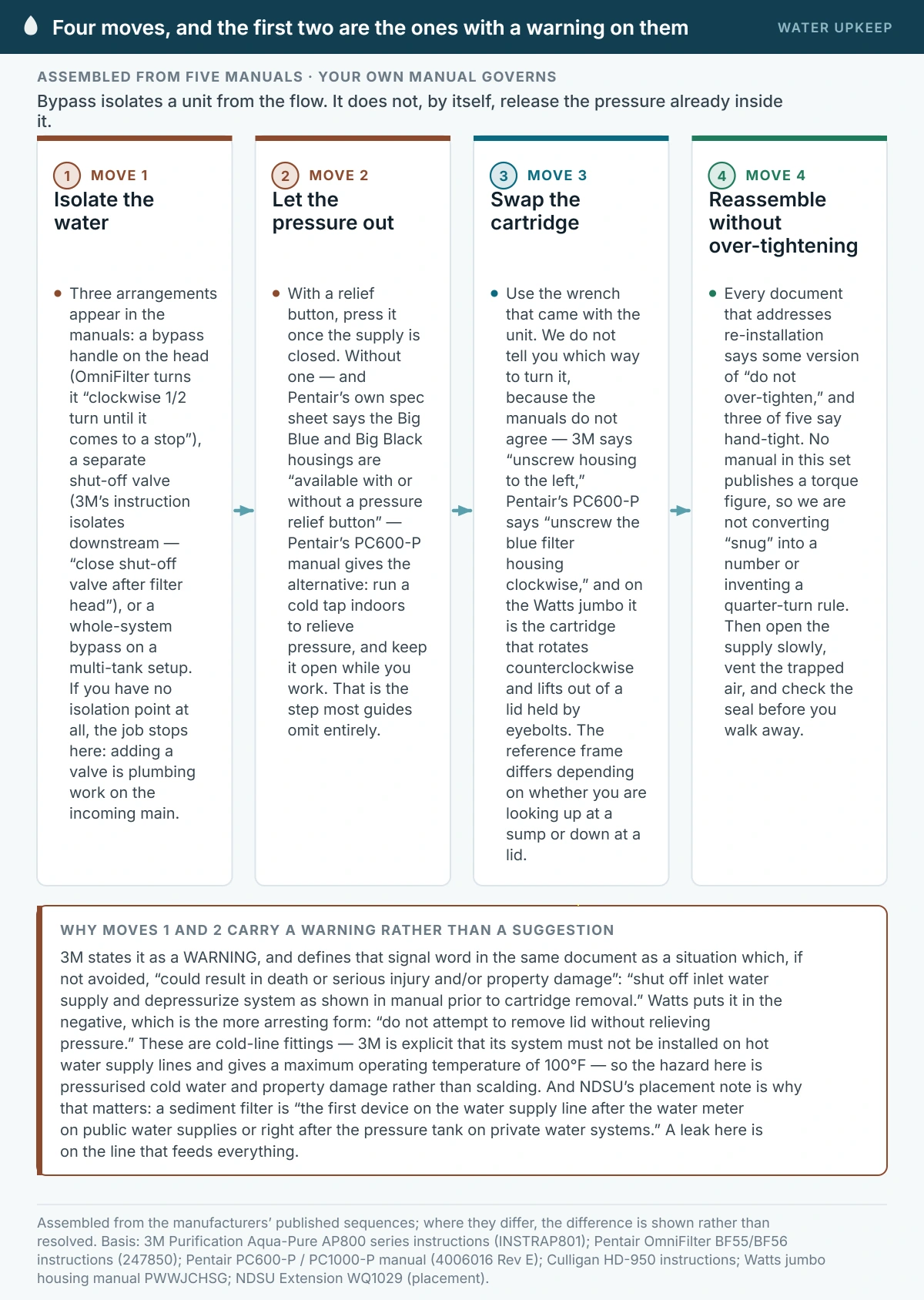
And one house rule that applies here exactly as it does to a softener bypass: putting a unit into bypass isolates it from the flow. It does not, by itself, release the pressure already inside it. Pentair’s own sequence proves the point — bypass the tanks first, then open a tap to relieve pressure.
3M states the rule as a WARNING, and 3M defines that signal word in the same document as a situation which, if not avoided, “could result in death or serious injury and/or property damage.” Their words, their risk category:
Shut off inlet water supply and depressurize system as shown in manual prior to cartridge removal.
Watts puts the same thing in the negative, which is the more arresting form: “do not attempt to remove lid without relieving pressure.”
What a whole house filter housing actually is
NDSU Extension gives the cleanest definition of the category: “whole-house refers to the placement of the filter rather than the filter type.” It also gives the placement: “a sediment filter should be the first device on the water supply line after the water meter on public water supplies or right after the pressure tank on private water systems.” That placement is why a leak here is different from a leak at a fixture — it is on the line that feeds everything.
A threaded-sump housing has five parts worth naming: the head (which carries the inlet, outlet and, sometimes, the relief button), the sump that screws onto it, the large O-ring that seals the two together, the standpipe the cartridge sits over, and the wrench that came with the unit. On the Pentek Big Blue family the O-ring is EPDM, with its own part number.
But not every housing is a sump you unscrew. The Watts jumbo housing opens at the top: you remove a lid held by eyebolts, and the cartridge itself rotates counterclockwise and lifts out. If your unit looks like that, most of what you read about unscrewing housings does not apply to you.
Pressure and temperature limits are a housing spec
| Housing (manufacturer document) | Pressure | Temperature | Relief button |
|---|---|---|---|
| 3M Aqua-Pure AP800 series (INSTRAP801) | Do not install above 100 psi; pressure limiting valve required above 80 psi | Max 100°F; not for hot water lines | Red vent button |
| Pentair Pentek Big Blue / Big Black (310053) | 100 psi (10″), 90 psi (20″) | 40–100°F | Available with or without |
| Pentair OmniFilter BF55 / BF56 (247850) | 30–90 psi | 40–100°F | Red pressure relief button |
| Culligan HD-950 | 30–100 psi | 40–100°F | Red pressure-relief button |
| Watts jumbo PWWJCHSG | Max 125 psi; relief valve required above 100 psi | 125°F at 80 psi | Pressure relief button |
| Pentair PC600-P / PC1000-P (4006016 Rev E) | 20–125 psi | 36–120°F | Not fitted; relieve at a tap |
Notice what that table settles. These are cold-line fittings. 3M is explicit: “do not install on hot water supply lines. The maximum operating water temperature of this system is 100°F.” So the hazard at a whole house filter housing is not scalding — it is pressurized cold water and property damage, which is exactly the risk category 3M’s own warning names. If you believe your filter is on a hot line, that is a question for a plumber about the installation, not a step in a cartridge change.
Four of the manuals also carry near-identical freeze cautions: the filter “must be protected against freezing, which can cause cracking of the filter and water leakage.” A cracked sump on the incoming main is a whole-house leak.
How to change the cartridge
Step 1: Isolate
Three arrangements show up in the manuals, and you need to know which you have.
- A built-in bypass handle on the head. OmniFilter’s BF55/BF56 manual: “bypass water to the filter by turning the handle clockwise 1/2 turn until it comes to a stop. This will shut off all water flow to the housing.” That direction and that half-turn are OmniFilter’s, for those models.
- A separate shut-off valve. 3M’s instruction is “close shut-off valve after filter head” — note that it isolates downstream. A well-installed housing has an isolation point on each side.
- A whole-system bypass. Pentair’s PC600-P manual has you shut off the water supply and bypass all tanks, then return the tanks to service afterwards.
Step 2: Depressurize
If your housing has a relief button, press it once the supply is closed and before you open anything. The manuals call it a red vent button (3M), a red pressure-relief button (Culligan and OmniFilter), or simply the pressure relief button (Watts).
If it does not have one, Pentair’s PC600-P manual gives the alternative: with the supply off and the system in bypass, run a cold water faucet indoors to relieve pressure — and keep it open while you work. That is the only published instruction we found for depressurizing a housing without a button, and it is the step most guides omit entirely.
Step 3: Open the housing
Use the wrench that came with the unit, seated correctly. We are deliberately not telling you which way to turn it, because the manuals do not agree: 3M says “unscrew housing to the left,” Pentair’s PC600-P manual says “unscrew the blue filter housing clockwise,” and on the Watts jumbo it is the cartridge, not the housing, that rotates — counterclockwise, then upward. The reference frame differs depending on whether you are looking up at a sump or down at a lid. Read yours.
3M adds a step several manuals skip: “wash housing thoroughly with mild soap and water” once the old cartridge is out.
Step 4: The O-ring — clean and re-seat, or replace?
The O-ring is the seal. It is also the first suspect in every post-change leak. Here is where the manuals split, on two questions at once.
| Document | Exact wording | Lubricant | New O-ring, or re-seat? |
|---|---|---|---|
| 3M Aqua-Pure AP800 (INSTRAP801) | “Lubricate o-ring with a water based lubricant.” | Water-based | Re-seat |
| Pentair OmniFilter BF55/BF56 (247850) | “Lubricate O-ring (C) with clean silicone.” | Silicone | Re-seat, wiped clean |
| Culligan HD-950 | “Lubricate O-ring with clean silicone grease.” | Silicone grease | Re-seat, wiped clean |
| Pentair PC600-P / PC1000-P (4006016 Rev E) | “Lubricate two new O-rings with clean silicone grease.” | Silicone grease | New |
| Watts PWWJCHSG | “From time to time, this O-ring may be lubricated with non-petroleum based lubricant.” | Non-petroleum (a category, not a product) | Check seating; lubricate if necessary |
Three of the five say silicone. One says water-based. One rules out a category rather than naming a product. We are not going to publish a house instruction on top of that, and we are not naming a brand. Read your manual; if it is silent, note that the one document that speaks to the question excludes petroleum-based products.
Note also that only one of the five — Pentair’s PC600-P — instructs fitting new O-rings rather than cleaning and re-seating the existing one. That is a real difference in what “a filter change” includes, and it is worth checking before you start rather than after.
Step 5: The new cartridge
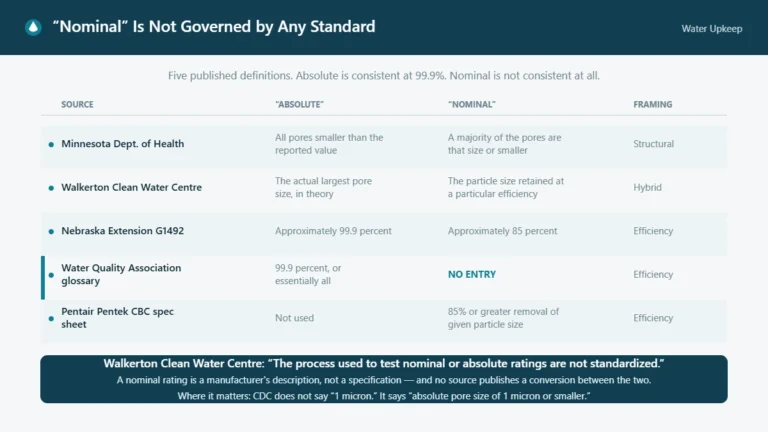
The cartridge sits over the standpipe in the bottom of the housing. Put the same rating back in unless you have a specific reason to change it — and if you do, the specification question (what micron rating, and what “nominal” actually means) is a subject in its own right, covered in what micron rating your water filter needs.
Step 6: Tightening
| Document | Exact wording | Hand or wrench? |
|---|---|---|
| 3M Aqua-Pure AP800 | “Insert new cartridge and re-install housing using housing wrench supplied with the product.” | Wrench on re-install |
| Pentair OmniFilter BF55/BF56 | “The housing wrench that is provided is only used for removing the housing when you change the cartridge.” / “Hand-tighten until snug. DO NOT OVER-TIGHTEN.” | Removal only; hand-tight |
| Culligan HD-950 | “Screw bottom of housing onto the cap and hand-tighten. DO NOT OVER-TIGHTEN.” | Hand-tight |
| Pentair PC600-P / PC1000-P | “Screw the blue filter housing hand-tight onto the filter cover. Lightly snug using the spanner wrench, ensuring not to over-tighten.” | Hand-tight, then lightly snug |
| Watts PWWJCHSG | “Replace eyebolts and tighten. (Hand tight is sufficient.)” | Hand-tight |
Every document that addresses re-installation says some version of “do not over-tighten,” and three of five say hand-tight. Only 3M puts the wrench on the way back in. No manual in this set publishes a torque figure, and we are not going to convert “snug” into a number or invent a quarter-turn rule.
Step 7: Water back on, slowly, and vent the air
Open the supply slowly to let the housing fill, then release trapped air — with the relief button if you have one (“depress red pressure-relief button to release trapped air,” in both Culligan’s and OmniFilter’s words), or at an open tap if you do not. Check for leaks at the seal before you walk away.
Step 8: Flush
| Document | Exact wording | Duration |
|---|---|---|
| 3M Aqua-Pure AP800 | “Flush system for five (5) minutes.” | 5 minutes |
| Culligan HD-950 | “Flush the cartridge for 10 minutes, wait one hour, then flush again for 10 minutes before using the water.” | 10 + 60 + 10 |
| Pentair OmniFilter BF55/BF56 | “Flush cartridge for 15 minutes before use.” | 15 minutes |
| Pentair PC600-P / PC1000-P | No timed flush; fill slowly to expel air, and “for 72 hours after installation, try not to use a high demand of water” | — |
| Watts PWWJCHSG | No timed flush; “vent filter to dispel air by depressing pressure relief button” | — |
Five, ten-plus-ten, fifteen, or none at all. We are not averaging those. Culligan’s two-stage flush with an hour’s wait in between is unique to that document and should be treated as Culligan’s instruction for the HD-950, not a general rule.
There is one published reason an initial flush exists, and it is specific to carbon media. Pentair’s PC600-P manual: “carbon dust may be released into the water lines of the house/building during the first few days of water use after carbon tank installation.”
When does it actually need changing?
Two university extension services give the same non-calendar answer, independently. Nebraska Extension G1492: “when a noticeable drop in water flow through the filter occurs, clean or replace the cartridge,” noting that flow “is greatest when a new or replacement cartridge is installed” and “gradually decreases as trapped material continues to accumulate.” UGA Extension B1523: “replace or clean the cartridge when there is a noticeable drop in water flow through the device.”
Watts gives the measured version of the same idea: a change-out trigger of 30 psi differential maximum for its sediment cartridge, and every 6 to 12 months for carbon, “depending on chlorine level and water usage.”
The manufacturer intervals are ceilings, not schedules, and each one belongs to a specific cartridge. And rated capacity in gallons is not a schedule either — look at the spread inside one manufacturer’s own catalog.
| Cartridge (Pentair Pentek spec sheets) | Rated capacity | At what flow |
|---|---|---|
| GAC-5 | 250 gallons | 0.5 gpm |
| GAC-10 | 5,000 gallons | 1.0 gpm |
| CBC-5 | Over 3,000 gallons | 1 gpm |
| CBC-10 | Over 20,000 gallons | 1 gpm |
| GAC-20BB | 25,000 gallons | 4.0 gpm |
| CBC-BB | Over 50,000 gallons | 2 gpm |
| CBC20-BB | Over 150,000 gallons | 4 gpm |
Those are chlorine taste-and-odor capacities, and they run from 250 gallons to 150,000 gallons in the same catalog. “A whole house filter lasts X gallons” is not a statement anyone can make. Worth noting too: those spec sheets state that several of the cartridges are “tested and certified by NSF International to NSF/ANSI Standard 42 for material requirements only.” That is a materials certification, not a performance claim, and the distinction is easy to lose when reading a listing.
Why the stages come out on different schedules
If you have a two- or three-stage setup, the sediment cartridge and the carbon stage are not on the same clock, and there is a published reason. EPA, in guidance written for small public water systems rather than homeowners, says that “adsorptive media units should be installed with a particulate pre-filter to remove particles followed by the vessel containing the adsorptive media,” and that the pre-filter “is typically used to remove particles and extend the life of GAC cartridges and RO membrane.” Nebraska Extension G1489 says the same thing more plainly: a sediment filter ahead of an activated carbon filter “will prolong the life of the AC filtration unit.”
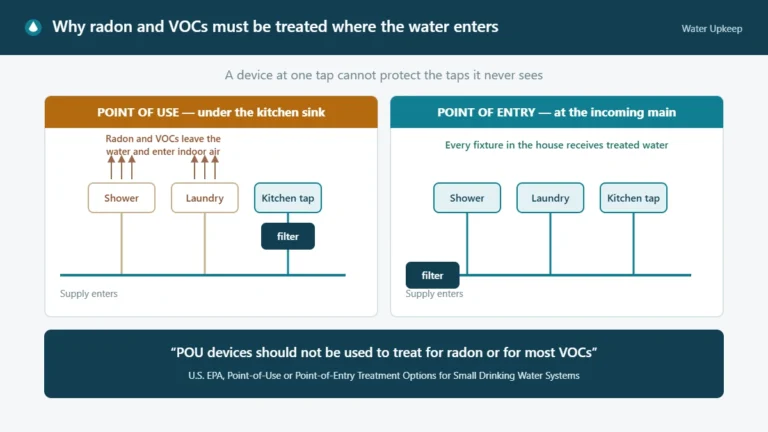
So the sediment stage is doing work on behalf of the carbon stage, and it fills up first. Selection of the system itself — including EPA’s finding about point-of-entry versus point-of-use treatment — is covered in whole house water filters.
When it will not come off
First, check the pressure again. A housing that resists because it is still pressurized is a different problem from one that is seized, and it is the dangerous one.
After that, here is the honest position. No manufacturer manual, no standards body, no extension service and no government source we could find publishes a procedure for a housing that will not come off. What the manufacturers publish is the wrench that came with the unit and its intended use — OmniFilter is explicit that “the housing wrench that is provided is only used for removing the housing when you change the cartridge.” That is the whole of the authorized toolset.
If the manufacturer’s wrench will not move a depressurized housing, stop there and call a licensed plumber. No manufacturer publishes a way to force a stuck housing, the sump is plastic, and every manual we opened lists cracking and leakage as how these housings fail. A seized housing on the incoming main is a whole-house leak waiting to happen — and it is a cheap call-out compared with what a burst housing costs.
Specifically: do not add leverage, do not apply heat, do not put penetrating oil or solvent on a potable-water fitting, and do not strike it.
Leaks and other things that go wrong afterwards
- A weep at the seal. The O-ring is the first suspect — misseated, pinched, dry, or damaged. Every manual has you clean the groove and seat the ring deliberately, and Pentair has you press the upper O-ring down into its groove with two fingers.
- Over-tightening is a failure mode, not insurance. Every manual that addresses it says not to do it.
- A cracked sump is a whole-house leak. Four manuals attach that failure specifically to freezing.
- Cloudy or dusty water after a carbon change. Air from the refill, which clears, and Pentair’s carbon dust caution for the first few days. If cloudiness persists or has other causes, see cloudy tap water.
- Electrical grounding. OmniFilter carries a shock warning: “if your water pipes are used to ground your home’s electrical system, install a No. 8 AWG jumper wire (or larger) around the filter,” and Pentair notes that installing a system in copper or galvanized pipe “will interrupt the continuity of the plumbing system and grounding source in some homes.” That is an installation condition to verify exists — not a DIY electrical job.
What a whole house filter is not
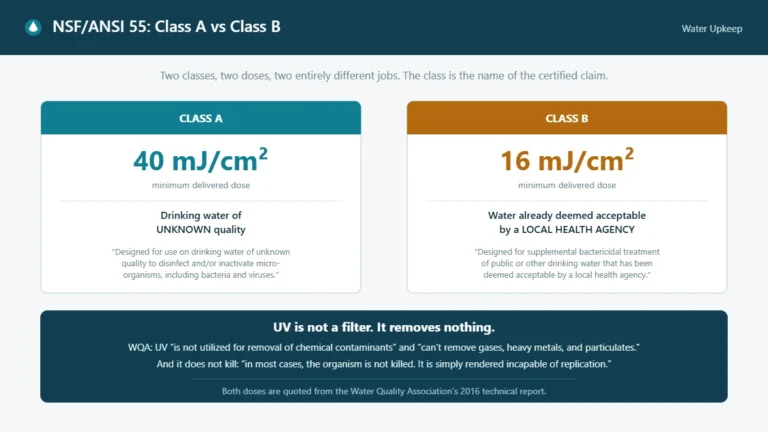
It is not a disinfection step. All five manuals carry the same sentence: “do not use with water that is microbiologically unsafe or of unknown quality without adequate disinfection before or after the system.” NDSU adds the specific version for carbon: “a bacteriostatic carbon filter is not adequate to treat water that is microbially unsafe.” If the safety of your supply is the question, that belongs with your local health department and, for wells, with well water filtration systems.
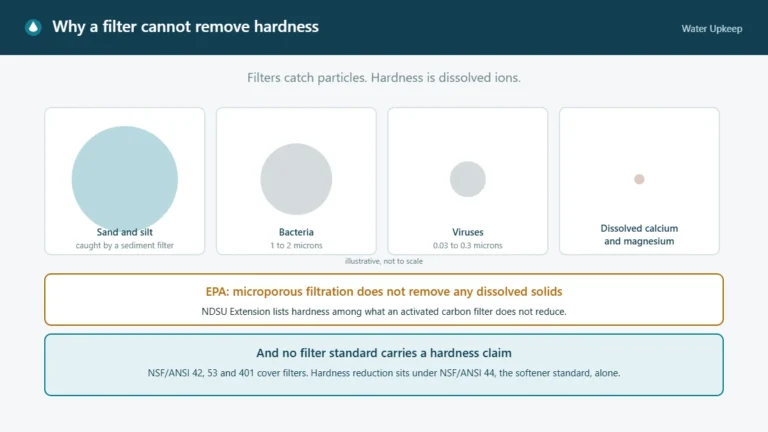
It is not a softener. A sediment or carbon cartridge does not remove hardness — see hard water filters for what that distinction actually means.
It is not a substitute for knowing what is in your water. Filter selection follows a test result, not the other way round; see what filtered water is and how to filter water at home.
Frequently asked questions
How often should I change a whole house water filter?
The trigger the extension services publish is a noticeable drop in flow. The manufacturer intervals — 3 months, 6 months, 9 months, 6 to 12 months depending on the cartridge — are ceilings that each come with an “or sooner” clause attached. We are not going to give you a house interval, because no independent source publishes one and the right answer depends on your water and your usage.
Do I have to turn the water off to change a whole house filter?
Yes, and the manuals say so as a warning rather than a suggestion. This is a pressurized fitting on the incoming main. It is worth noting the contrast with a refrigerator filter, where at least one manufacturer says the supply does not have to be shut off — a different device with a different design, covered in how often to change a refrigerator water filter.
What do I put on the O-ring?
Whatever your manual says. Three of the five we opened say silicone or silicone grease, one says a water-based lubricant, and the one manual that speaks to it in category terms excludes petroleum-based products. We are not making a house recommendation on top of a genuine disagreement, and we are not naming a brand.
How tight should the housing be?
Not tighter than your manual says. Every document that addresses it warns against over-tightening; three of five say hand-tight; one says hand-tight then lightly snug with the wrench; one uses the wrench on the way back in. No manual publishes a torque figure, so neither will we.
Do I need to sanitize the housing when I change the filter?
The Water Quality Association publishes a full sanitizing procedure for residential drinking water treatment systems, including a specific disinfectant concentration and contact time. We do not reproduce doses on this page. What we will pass on are the qualitative steps it prints: remove and discard the used filter; drain and wash the inside of the housing with detergent using a cloth or sponge; use only potable, microbiologically safe water for cleaning and rinsing; and flush at least two unit-volumes of water through the system afterwards to remove any residual disinfectant. For the dose, read the WQA document itself.
Why is my water cloudy after changing the filter?
Air from the refill is the usual answer and it clears on its own. After a carbon change, Pentair’s manual notes that carbon dust may be released for the first few days. If it persists, cloudy tap water covers the other causes.
Does a whole house filter make well water safe to drink?
No. Every manual we opened says not to use these systems with water that is microbiologically unsafe or of unknown quality without adequate disinfection. That question belongs with your local health department.
Sources and standards
- University of Nebraska–Lincoln Extension — G1492, Drinking Water Treatment: Sediment Filtration
- University of Georgia Cooperative Extension — B 1523, Mechanical Filtration Methods and Devices
- NDSU Extension — WQ1029, Filtration: Sediment, Activated Carbon, and Mixed Media
- US EPA — Point-of-Use or Point-of-Entry Treatment Options for Small Drinking Water Systems (EPA 815-R-06-010), written for small public water systems
- Water Quality Association — Guidance for Sanitizing Residential Drinking Water Treatment Systems and the Granular Activated Carbon fact sheet
- 3M Purification (manufacturer documentation) — Aqua-Pure AP800 series installation and operating instructions
- Pentair (manufacturer documentation) — OmniFilter BF55 and BF56 instructions, the PC600-P and PC1000-P system manual, the Big Blue and Big Black housing spec sheet, and the CBC and GAC cartridge spec sheets
- Watts (manufacturer documentation) — Jumbo cartridge filter housing manual, model PWWJCHSG
- Culligan (manufacturer documentation) — HD-950 installation and operating instructions (manufacturer document, retailer-hosted copy)
Last reviewed September 9, 2026.