How to Filter Water at Home: Match the Method to the Problem
Filtering water at home starts with a test, not a purchase. Every household treatment method — activated carbon, reverse osmosis, ultraviolet, ion exchange, sediment filtration — is good at a narrow set of problems and useless against the rest. EPA puts the order plainly: “Find out what is in your water and what you might want to remove before contacting potential dealers.” CDC says the same thing from the other end: “Test your water and choose a filter that removes the harmful germs or chemicals you are concerned about.”
That is the whole method. What follows is what each technology actually does, in the words of the agencies and certifiers that publish on it, and what none of them will do no matter what the box says.
Step one: find out what is in your water
If you are on a public water system, you already have a document that answers most of this. EPA requires community water systems to deliver a Consumer Confidence Report — an annual drinking water quality report — and “reports must be sent by your water supplier each year by July 1.” It names the source, summarises contamination risk, lists regulated contaminants detected, and describes corrective action taken. (EPA, CCR Information for Consumers)
If you are on a private well, nobody sends you anything. EPA’s route is a laboratory, not a strip: “You can have your water tested by a state certified laboratory,” and its baseline for wells is to “test water every year for total coliform bacteria, nitrates, total dissolved solids and pH levels.” EPA advises testing more often if the household is expecting an infant, if there is unexplained illness, or if the water changes in appearance, taste or smell. Our guide to water testing covers how to read the results.
Match the method to the problem
NSF publishes a one-line definition of each treatment category and the standard that governs it. This table is a map of the territory, not a recommendation — which row applies to you depends entirely on what your test found.
| Standard | Technology | What it addresses |
|---|---|---|
| NSF/ANSI 42 | Filtration — aesthetic effects | Chlorine, taste and odor |
| NSF/ANSI 53 | Filtration — health effects | Contaminants with a health effect, such as lead and cysts |
| NSF/ANSI 58 | Reverse osmosis | Pressure forces water through a semi-permeable membrane |
| NSF/ANSI 62 | Distillation | Water is boiled and the vapour collected as it condenses |
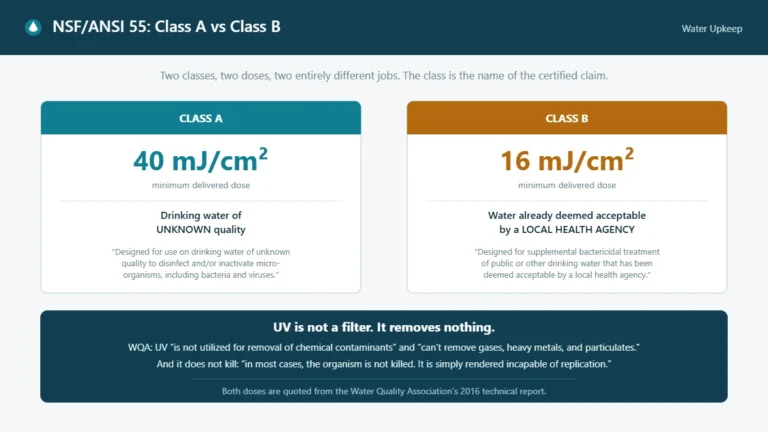
| NSF/ANSI 55 | Ultraviolet | UV light inactivates bacteria, viruses and cysts |
| NSF/ANSI 44 | Cation exchange softening | Hardness — calcium and magnesium |
| NSF/ANSI 177 | Shower filters | Certified only to reduce free available chlorine |
| NSF/ANSI 401 | Emerging contaminants | Point-of-use and point-of-entry systems |
Note NSF/ANSI 177 in particular: a shower filter is certified to do exactly one thing, and it is not a general-purpose device.
Activated carbon: the workhorse, and its blind spots
Carbon is what is inside most pitchers, faucet mounts and refrigerator filters. The Water Quality Association describes granular activated carbon as working “to reduce undesirable taste, odor and color and to improve the safety of drinking water by also effectively removing common disinfection byproducts (THMs), organic contaminants like chlorinated solvents and other industrial pollutants, pesticides, and select heavy metals such as lead and mercury.” It also “catalytically reduce[s] chlorine from an oxidizer (NaOCl) to a salt (NaCl).”
WQA is equally specific about a blind spot: “Low MW alcohols such as methanol and ethanol for instance are very soluble in water and not removed by GAC.” And carbon is consumable, not permanent: “At some point, GAC becomes exhausted and you would need to re-bed the media.” (WQA, Granular Activated Carbon Fact Sheet)
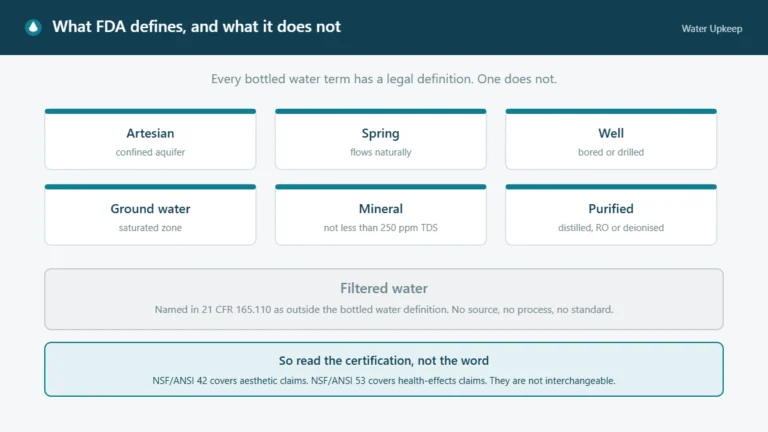
A pitcher or fridge filter belongs in the aesthetic category unless that specific model carries an NSF/ANSI 53 or 401 certification for the contaminant you care about. CDC groups “pitcher filters and filters built into refrigerators” under improving taste and smell. A category claim is not a product claim. See what filtered water actually means for more on that distinction.
Reverse osmosis and nanofiltration: the membrane processes
NSF describes reverse osmosis as using “reverse pressure to force water through a semi-permeable membrane.” It is the only household filtration approach CDC lists against all three classes of organism: “Reverse osmosis filters remove parasites, bacteria, and viruses.” On CDC’s home-filters guidance, nanofiltration and reverse osmosis are the only two entries listed against viruses at all.
RO is also the standard route for dissolved contaminants that carbon cannot touch. If your test came back with a dissolved contaminant rather than an aesthetic complaint, this is usually the category to look at — and our guide to what a reverse osmosis system costs covers what that decision involves.
Ion exchange handles hardness. It is not general filtration.
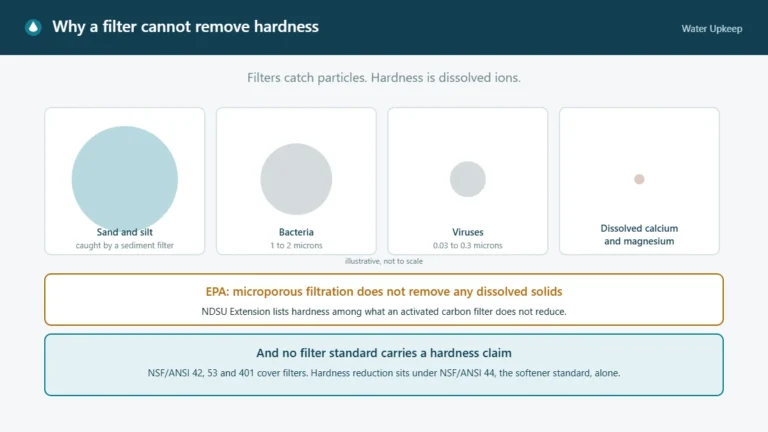
WQA describes ion exchange as used for “removal of hardness (as in softening), heavy metals (as in waste treatment), radionuclides (as from power plants)” and municipal feeds, with resins “regenerated with salt (sodium or potassium chloride).” The line most homeowners need is the limitation: “Softeners do not reduce the total dissolved solids (TDS) or dissolved mineral content of water.” (WQA, Ion Exchange Fact Sheet)
A softener swaps calcium and magnesium for sodium or potassium. It does not make water cleaner in any broader sense, and it is certified under its own standard, NSF/ANSI 44. If scale is your complaint, see how to treat hard water; if a contaminant is your complaint, a softener is the wrong device.
Sediment filtration removes particles, and only particles
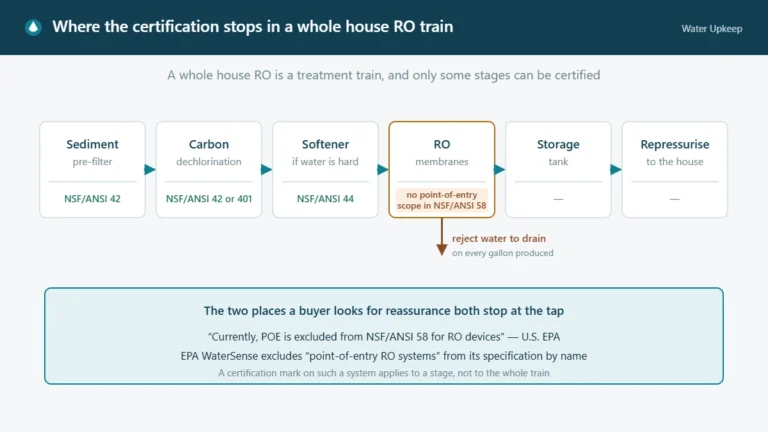
Virginia Cooperative Extension defines the job precisely: sediment filters remove “suspended particles found in water (e.g., sand, silt, clay, and oxidized iron and manganese).” That is genuinely useful — particles foul membranes, clog carbon and wear valves — but it is a mechanical process. Nothing dissolved is affected. A sediment filter is usually the first stage in a whole-house filtration train, protecting whatever comes after it.
UV disinfects. It removes nothing.
WQA is unambiguous: ultraviolet light “utilizes radiation disrupting cellular DNA to kill microbes but is not utilized for removal of chemical contaminants.” UV also appears “as a final step in reverse osmosis (RO) systems to improve the efficiency of microbe removal originating from the source water or that may grow in the POU system over time.” UV units require routine cleaning, sanitising, filter changes and lamp replacement. (WQA, Treatment of Residential Drinking Water Using UV)
Put plainly: after UV treatment, everything that was dissolved in the water is still dissolved in the water. The organisms are inactivated; nothing has left.
Pore size: what CDC publishes, and what it deliberately does not
CDC gives two absolute pore sizes and stops there:
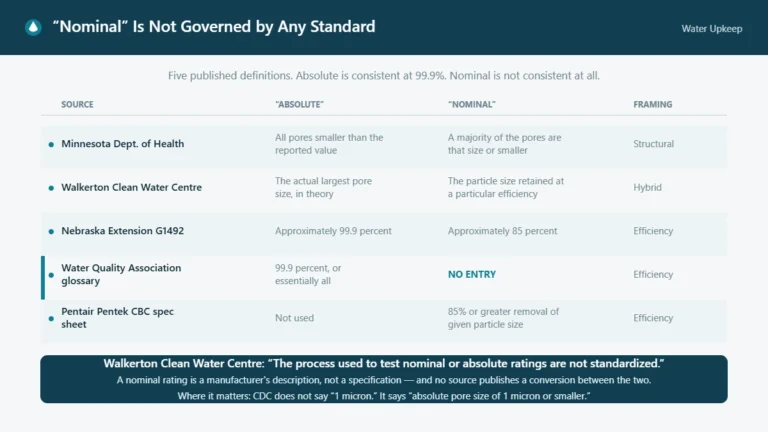
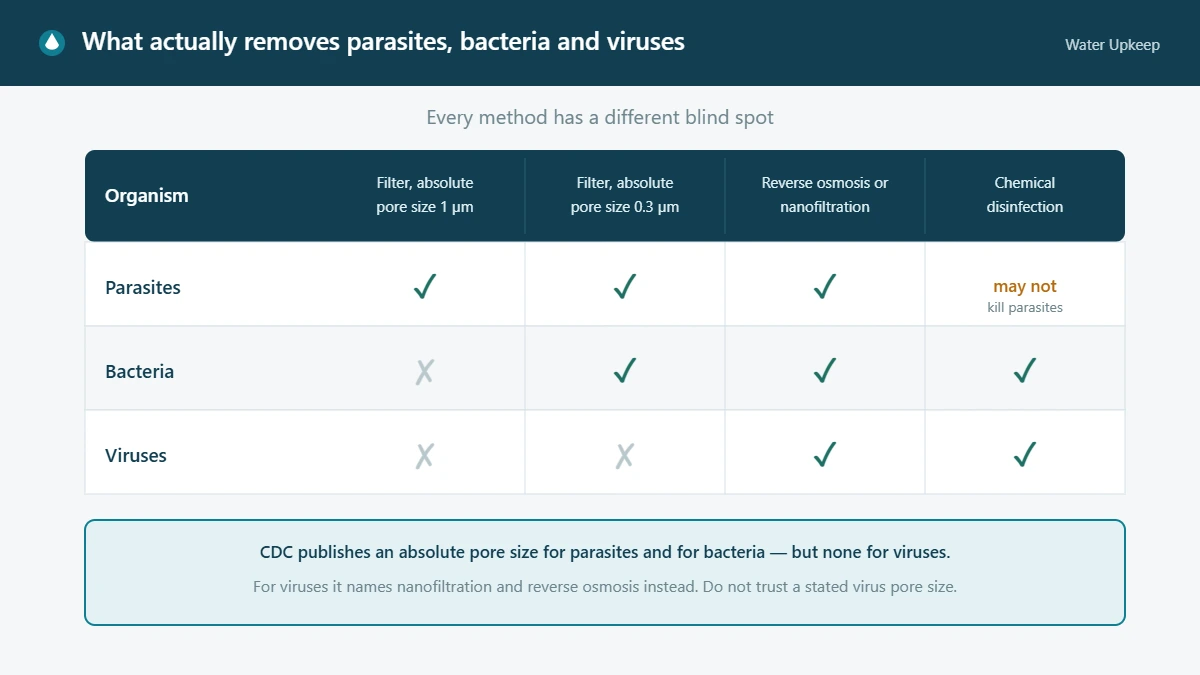
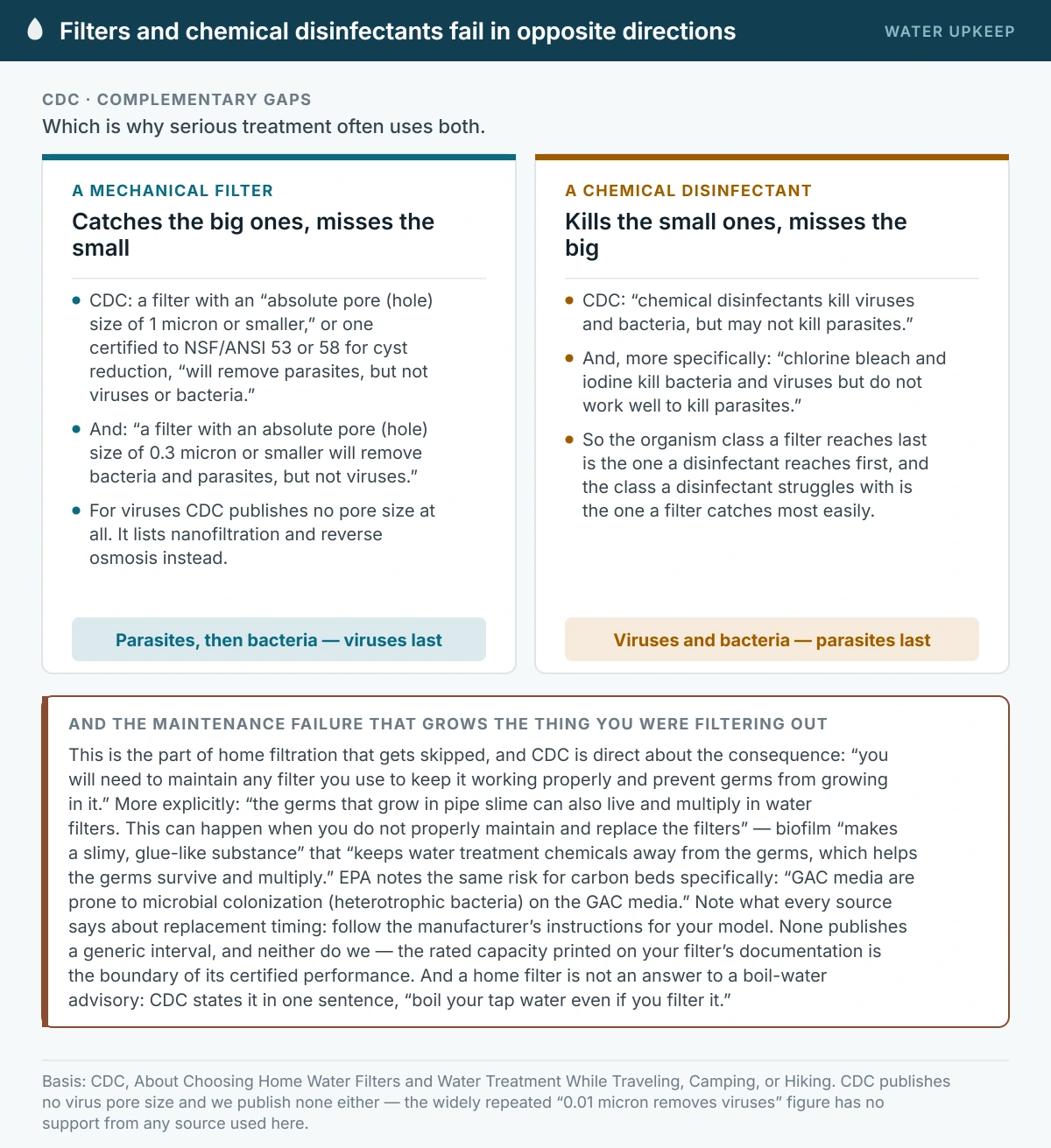
- Parasites. A filter with an “absolute pore (hole) size of 1 micron or smaller,” or one “certified for NSF standards 53 or 58 for cyst reduction or removal,” “will remove parasites, but not viruses or bacteria.”
- Bacteria. “A filter with an absolute pore (hole) size of 0.3 micron or smaller will remove bacteria and parasites, but not viruses.”
- Viruses. CDC publishes no pore size. It lists nanofiltration and reverse osmosis instead.
The widely repeated “0.01 micron removes viruses” figure has no support from any of the sources used here, and we are not going to publish one. CDC’s position is that pore size answers the parasite and bacteria questions, and a membrane process or a chemical or UV step answers the virus question.
The two approaches also have complementary gaps. CDC: “Chemical disinfectants kill viruses and bacteria, but may not kill parasites,” and “chlorine bleach and iodine kill bacteria and viruses but do not work well to kill parasites.” Filters and chemicals fail in opposite directions, which is why serious treatment often uses both.
Certification is claim-specific
The Minnesota Department of Health gives the two-sentence version that saves people the most money: “Select a treatment unit certified by NSF, Underwriter’s Laboratory (UL), or Water Quality Association (WQA)” — and “these organizations do not certify treatment units for all contaminants.” (Minnesota Department of Health, Home Water Treatment Facts)
A certification mark on a box means the product was tested against a named standard for named claims. It does not mean the product handles whatever is in your water. EPA makes the same point about the contaminant people most often shop for: “If you use a filter to remove lead, be sure you get one that is certified to remove lead.” NSF’s consumer advice is to “read product labels and other literature carefully so that you understand the potential capabilities of the product as well as any operational limitations.”
A neglected filter grows the thing you were filtering out
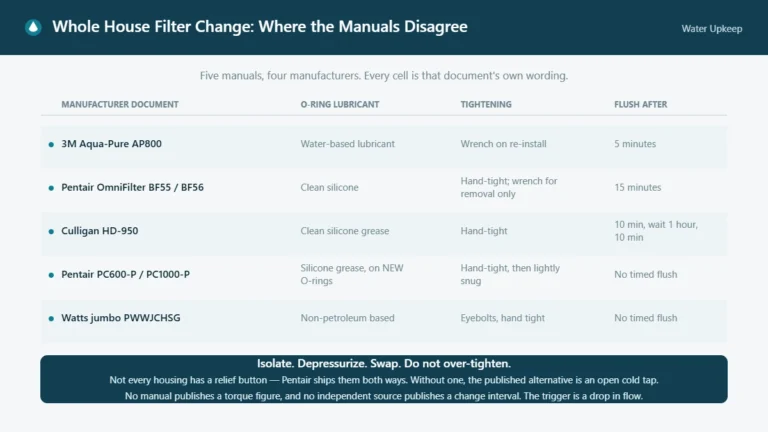
This is the part of home filtration that gets skipped, and CDC is direct about the consequence: “You will need to maintain any filter you use to keep it working properly and prevent germs from growing in it. This includes regularly changing the filters according to the manufacturer’s recommendations.”
More explicitly still: “The germs that grow in pipe slime can also live and multiply in water filters. This can happen when you do not properly maintain and replace the filters.” Biofilm “makes a slimy, glue-like substance” that “keeps water treatment chemicals away from the germs, which helps the germs survive and multiply.” EPA notes the same risk for carbon beds specifically: “GAC media are prone to microbial colonization (heterotrophic bacteria) on the GAC media.”
Note what every allowed source says about replacement timing: follow the manufacturer’s instructions for your model. None of them publishes a generic interval, and neither will we. The rated capacity printed on your filter’s documentation is the boundary of its certified performance.
Emergency treatment is a different problem
A home filter is not an answer to a boil-water advisory. CDC states it in one sentence: “Boil your tap water even if you filter it. For example, still boil tap water if it has been through a home water filter or a pitcher that filters water.”
For boiling, the two federal agencies agree on the times and differ on the altitude threshold, so here are both. EPA: “Bring water to a rolling boil for at least one minute. At altitudes above 5,000 feet (1,000 meters), boil water for three minutes.” CDC: “Bring clear water to a rolling boil for 1 minute (at elevations above 6,500 feet, boil for 3 minutes).” If the water is cloudy, EPA says to let it settle and filter it through a clean cloth, paper towel or coffee filter first.
If boiling is not possible, EPA publishes a strength-specific bleach procedure. Use unscented household bleach — “do not use scented, color safe, or bleaches with added cleaners” — and add “8 drops of 6% bleach, or 6 drops of 8.25% bleach, to each gallon of water,” then “stir and let stand for 30 minutes. The water should have a slight chlorine odor.” Doses vary by bleach strength, so follow EPA’s published table rather than a remembered rule of thumb.
What no home treatment will fix
CDC states the hard limit, and the wording is CDC’s rather than EPA’s: “You cannot make water containing fuel, toxic chemicals, or radioactive materials safe by boiling or disinfecting it.” CDC repeats it for camping and travel, adding: “Use bottled water or a different source of water instead.”
EPA’s own formulation on the same subject is narrower and worth quoting accurately: “boiling or disinfection will not destroy other contaminants, such as heavy metals, salts, and most other chemicals.” Both statements point the same direction. Boiling and disinfection are germ-killing steps. They are not purification, and they do not remove anything.
That is the honest summary of home water filtration as a whole. Test first. Read the certification for the specific claim you need. Maintain the equipment. And treat any suggestion that one device handles everything as a marketing claim rather than a technical one.
Sources
- U.S. EPA — Home Water Testing (fact sheet); CCR Information for Consumers; Emergency Disinfection of Drinking Water; Point-of-Use or Point-of-Entry Treatment Options for Small Drinking Water Systems; Certified drinking water laboratories
- U.S. CDC — About Choosing Home Water Filters; Water Treatment While Traveling, Camping, or Hiking; How to Make Water Safe in an Emergency; Drinking Water Advisories: An Overview; Preventing Waterborne Germs at Home
- NSF — Standards for Water Treatment Systems; Product Label and Literature Claims
- Water Quality Association — Granular Activated Carbon Fact Sheet; Ion Exchange Fact Sheet; Treatment of Residential Drinking Water Using UV
- Minnesota Department of Health — Home Water Treatment Facts
- Virginia Cooperative Extension, Virginia Tech — Household Water Treatment, publication 442-670
Last reviewed September 9, 2026.