Whole House Reverse Osmosis System: Why the Standard Excludes It
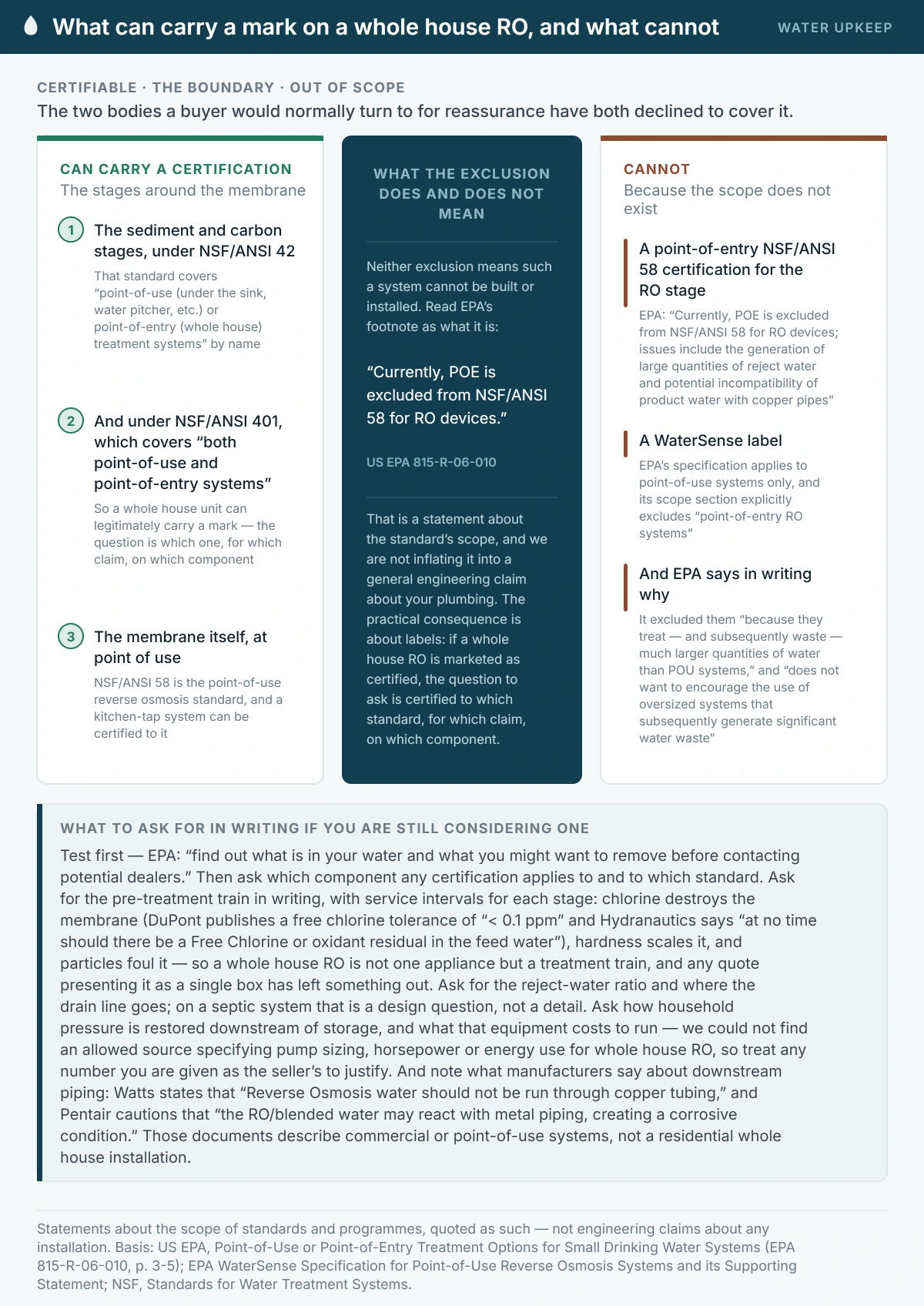
A whole house reverse osmosis system is an unusual purchase, because the two bodies a buyer would normally turn to for reassurance have both declined to cover it. NSF/ANSI 58, the reverse osmosis standard, has no point-of-entry scope. EPA’s WaterSense programme excludes point-of-entry RO systems by name. Neither exclusion means such a system cannot be built or installed — but it does mean the certification mark you are used to looking for does not exist for the RO stage of a whole house unit.
That is the honest starting point. What follows is what the published record actually says, including the points where the published record stops and we are therefore not going to assert anything.
NSF/ANSI 58 has no point-of-entry scope
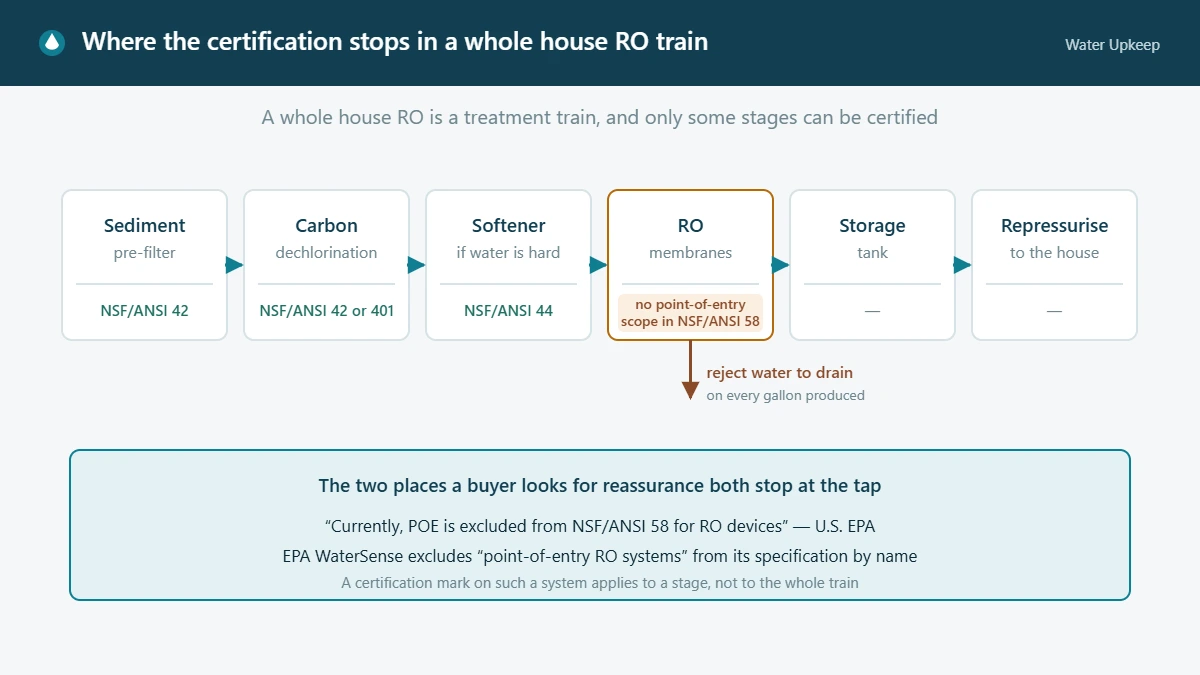
EPA states it in a footnote to its point-of-use and point-of-entry guidance, and the sentence is worth reading whole: “Currently, POE is excluded from NSF/ANSI 58 for RO devices; issues include the generation of large quantities of reject water and potential incompatibility of product water with copper pipes.” (EPA 815-R-06-010, p. 3-5)
That is EPA describing why the standard’s scope is drawn where it is. We are quoting it as exactly that — a statement about the standard — and we are not going to inflate it into a general engineering claim about your plumbing. The manufacturers’ own documents on that point are a separate matter, and they are further down.
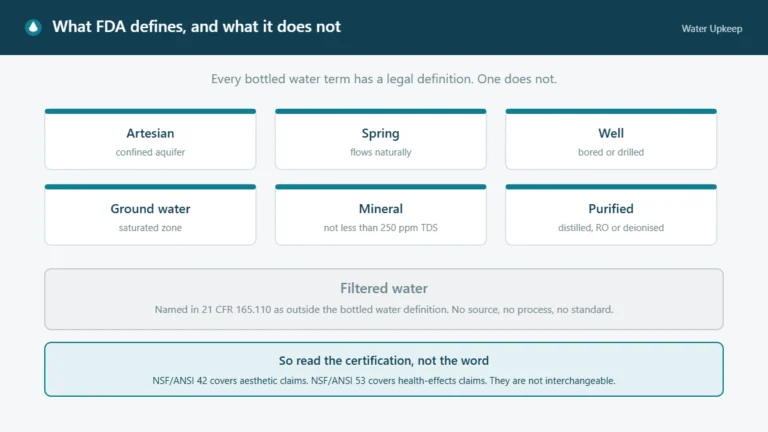
The practical consequence is about labels. NSF/ANSI 42 covers “point-of-use (under the sink, water pitcher, etc.) or point-of-entry (whole house) treatment systems,” and NSF/ANSI 401 covers “both point-of-use and point-of-entry systems.” So the sediment and carbon stages of a whole house RO can legitimately carry a certification. The RO membrane stage cannot carry a point-of-entry NSF/ANSI 58 certification, because that scope does not exist. If a whole house RO is marketed as certified, the question to ask is: certified to which standard, for which claim, on which component.
EPA’s water-efficiency programme excludes it too — and says why
EPA’s WaterSense specification for reverse osmosis systems applies to point-of-use systems only. Its scope section explicitly excludes “point-of-entry RO systems,” and EPA’s landing page repeats it: “point-of-entry systems are not addressed in this specification.”
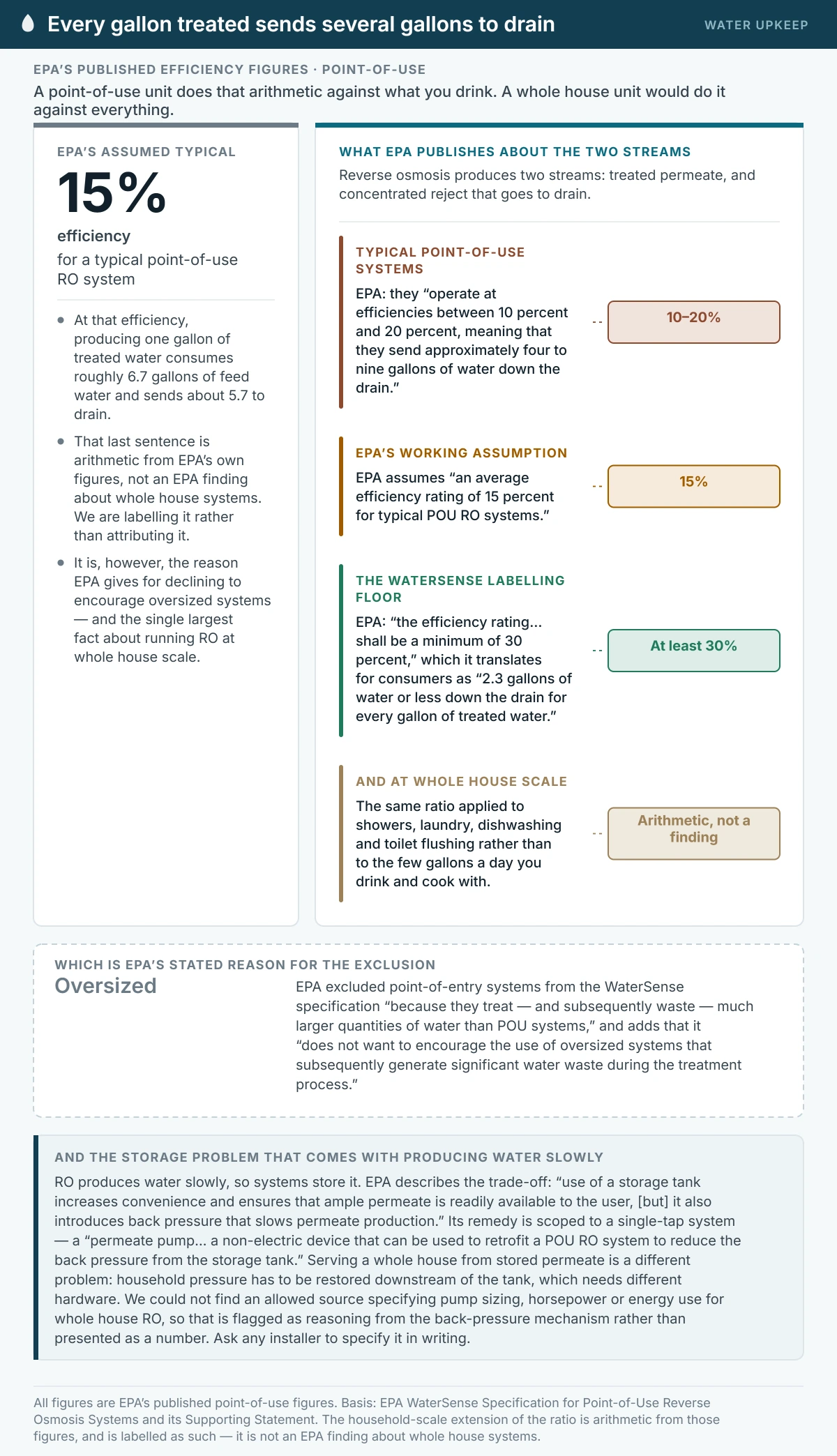
The reason is in EPA’s supporting statement, and it is a design judgement rather than an oversight: “EPA chose to exclude point-of-entry (POE) systems from the scope of the specification because they treat — and subsequently waste — much larger quantities of water than POU systems.” And, more pointedly: “EPA, therefore, does not want to encourage the use of oversized systems that subsequently generate significant water waste during the treatment process.” (EPA WaterSense Supporting Statement)
The reject-water arithmetic
Reverse osmosis produces two streams: treated permeate and concentrated reject that goes to drain. EPA quantifies the baseline for point-of-use units: “typical POU RO systems operate at efficiencies between 10 percent and 20 percent, meaning that they send approximately four to nine gallons of water down the drain,” and EPA assumes “an average efficiency rating of 15 percent for typical POU RO systems.” Its labelling threshold sets a floor: “the efficiency rating… shall be a minimum of 30 percent,” which EPA translates for consumers as sending “2.3 gallons of water or less down the drain for every gallon of treated water.”
Now apply that ratio to household demand rather than drinking-water demand. At EPA’s stated typical efficiency of 15 percent, producing one gallon of treated water consumes roughly 6.7 gallons of feed water and sends about 5.7 gallons to drain. A point-of-use unit does that arithmetic against the few gallons a day you drink and cook with. A whole house unit would do it against showers, laundry, dishwashing and toilet flushing. That is not an EPA finding about whole house systems — it is arithmetic from EPA’s published efficiency figures — but it is the reason EPA declined to encourage oversized systems, and it is the single largest fact about running RO at whole house scale.
Membranes need pre-treatment, and it is not optional
The following comes from manufacturer technical documentation — the manuals membrane makers publish for the engineers who design systems around their products. It is the clearest available statement of what a membrane needs to survive.
- Chlorine destroys the membrane. DuPont’s FilmTec technical manual states that “the free chlorine tolerance of the membrane is < 0.1 ppm” and that FilmTec “recommends removing residual free chlorine by pretreatment prior to membrane exposure.” Hydranautics puts it more strictly still in its technical service bulletin: “at no time should there be a Free Chlorine or oxidant residual in the feed water.” On a municipal supply, that means dechlorinating the entire house flow ahead of the membranes — a whole-house carbon bed, which then carries its own maintenance obligations.
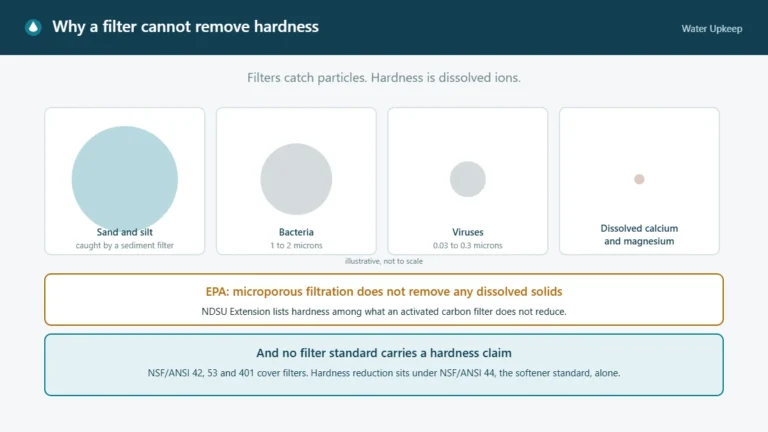
- Hardness scales the membrane. EPA: “high levels of water hardness tend to reduce membrane efficacy and result in more frequent replacement of the RO membrane. Also, high levels of iron, manganese, and aluminum can also cause membrane fouling.” DuPont’s manual devotes an entire section to scale control, listing acid addition, scale inhibitor addition and softening with a strong acid cation exchange resin among the options. On hard water, a softener in front of the RO is membrane protection, not an upsell.
- Particles foul the membrane. EPA requires a particulate pre-filter ahead of adsorptive media units generally; Hydranautics references a “typical 5-micron cartridge filter” as standard pre-filtration.
Read as a whole, a whole house RO is not one appliance. It is a treatment train — sediment, carbon, softening where needed, membranes, storage, repressurisation — and every stage has its own service interval. Any quote that presents it as a single box has left something out.
Storage tanks and pressure
RO produces water slowly, so systems store it. EPA describes the trade-off: “use of a storage tank increases convenience and ensures that ample permeate is readily available to the user, [but] it also introduces back pressure that slows permeate production.” EPA’s remedy for point-of-use systems is a “permeate pump… a non-electric device that can be used to retrofit a POU RO system to reduce the back pressure from the storage tank.”
Note the scope of that carefully: EPA is describing a non-electric device for a single-tap system. Serving a whole house from stored permeate requires restoring household pressure downstream of the tank, which is a different problem with different hardware. We could not find an allowed source specifying pump sizing, horsepower or energy use for whole house RO, so we are flagging that as reasoning from the back-pressure mechanism rather than presenting a number. Ask any installer to specify it in writing.
What RO is genuinely good at
None of the above is an argument against reverse osmosis. WQA describes the membrane as able to remove “bacteria, virus, soluble organic compounds such as pesticides and herbicides, and heavy metals such as arsenic, barium, cadmium, chromium, copper, lead, fluoride, nitrate.” CDC confirms the microbiological side: “reverse osmosis filters remove parasites, bacteria, and viruses.” DuPont’s manual gives typical performance as “rejection of dissolved salts is typically 95% to greater than 99%.”
EPA lists point-of-use RO as a small system compliance technology “for arsenic, uranium, and radium” and also “for copper, lead, fluoride,” with nitrate flagged for further investigation. Those are regulatory designations for small water systems, not household health guarantees — but they tell you what the technology is respected for.
One thing membranes do not do: DuPont’s and Veolia’s technical documentation both note that dissolved gases pass through. Veolia’s water handbook states that “due to their molecular porosity, RO membranes do not remove dissolved gases, such as Cl2, CO2, and O2.”
The asymmetry that answers the question
Look at the contaminants in that list again: arsenic, uranium, radium, lead, fluoride, nitrate. Every one of them reaches you by ingestion. You are exposed by drinking the water, which is exactly what a point-of-use system at the kitchen tap addresses — and every EPA listing above is for point-of-use RO.
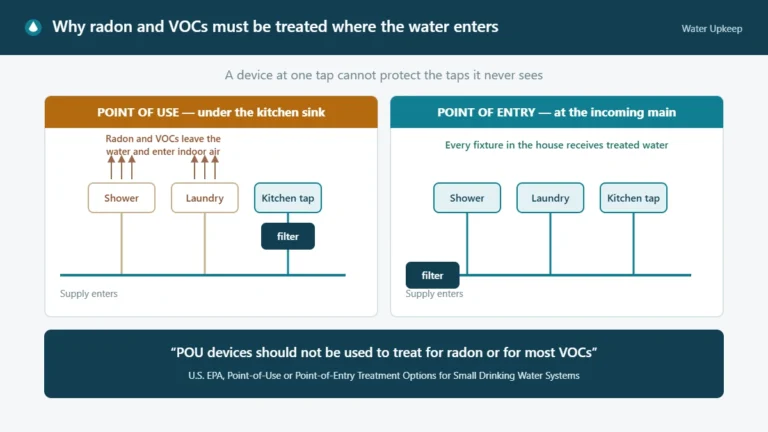
The contaminants that genuinely require treating the whole house are the ones that leave the water and enter the air: radon and most volatile organic compounds. EPA states that point-of-use devices “should not be used to treat for radon or for most VOCs” because they do not protect against “inhalation or contact exposure to these contaminants at untreated taps.” And for those, EPA prescribes point-of-entry granular activated carbon or aeration — not reverse osmosis.
That is the asymmetry. The problems that justify whole house treatment are not the problems RO is the answer to, and the problems RO is the answer to do not require whole house treatment. Our guide to whole house filtration and point-of-entry treatment covers the cases where a point-of-entry system genuinely is the right call.
If you are still considering one, check these
- Test first. EPA: “find out what is in your water and what you might want to remove before contacting potential dealers.” See water testing.
- Ask which component any certification applies to, and to which standard. NSF/ANSI 58 has no point-of-entry scope, so an RO stage cannot carry it at whole house scale.
- Ask for the pre-treatment train in writing — dechlorination, softening where the hardness requires it, sediment filtration — with service intervals for each stage.
- Ask for the reject-water ratio and where the drain line goes. On a septic system this is a design question, not a detail.
- Ask how household pressure is restored downstream of storage, and what that equipment costs to run.
- Check the contaminant, not the brand. The Minnesota Department of Health’s reminder applies to every category: certification bodies “do not certify treatment units for all contaminants.” Look your contaminant up in NSF’s listing or WQA’s.
What RO permeate does to metal plumbing
Reverse osmosis equipment manufacturers acknowledge in their own technical documentation that RO product water is aggressive to metal plumbing. Marlo Incorporated’s operation manual for its MRO-2.5 1500 GPD system warns that “the pH of the reverse osmosis permeate will normally be 1-2 points lower than the feed water pH. A pH of 6.5 or lower can be very aggressive to some plumbing materials, such as copper piping.”
Watts is blunter in its 4-Stage RO manual: “Reverse Osmosis water should not be run through copper tubing as the purity of the water will leach copper causing an objectional taste in water and pin holes may form in the tubing” — adding that it supplies specialty filters for installations where copper tubing follows the RO unit. Pentair’s EZ-RO installation guide cautions that “the RO/blended water may react with metal piping, creating a corrosive condition,” and specifies that “plastic pipe or reinforced opaque beverage tubing are acceptable choices for optimized water distribution.”
Two boundaries belong on that evidence, and we are stating them rather than letting the quotes run further than they should. Every one of those documents describes a commercial or point-of-use system, not a residential whole house installation — the principle is stated by RO equipment manufacturers, not specifically about a house. And although Pentair’s EZ-RO line does add “back calcium and magnesium from the mineral addition cartridge” and lets operators “blend back additional TDS,” Pentair frames that as tuning water quality for ice and coffee equipment, not as protecting plumbing. No manufacturer document we found makes remineralisation a plumbing-protection measure, so neither will we.
We are also keeping EPA’s footnote separate from all of this. EPA names copper-pipe compatibility as a reason NSF/ANSI 58’s scope stops where it does; that is a fact about the standard. The manufacturers’ statements above stand on their own documents and do not need it. What the two together mean in practice is simple enough: downstream piping material is a real design question on any RO installation, and it belongs in writing from whoever specifies the system.
The bottom line
Reverse osmosis is an excellent technology deployed at the right scale, and the right scale is almost always a tap. Two federal touchpoints — the certification standard and the water-efficiency programme — both stop at the point of use, and EPA has said in writing why. If your test result points at arsenic, lead, nitrate or fluoride, a certified point-of-use system addresses the exposure route those contaminants actually use. If it points at radon or volatile organics, you do need whole house treatment, but the technology EPA names is carbon or aeration.
A whole house RO can be engineered. It is just rarely the shortest path between the problem you have and the water you want, and anyone selling you one should be able to explain the pre-treatment, the reject stream and the pressure system before they explain the price. If cost is where you are starting, our breakdown of what a reverse osmosis system costs covers the point-of-use case in detail.
Sources
- U.S. EPA — Point-of-Use or Point-of-Entry Treatment Options for Small Drinking Water Systems (EPA 815-R-06-010); WaterSense Specification for Point-of-Use Reverse Osmosis Systems; WaterSense Supporting Statement; WaterSense: Point-of-Use Reverse Osmosis Systems; Home Water Testing
- Water Quality Association — Reverse Osmosis Fact Sheet; Treatment of Residential Drinking Water Using UV
- NSF — Standards for Water Treatment Systems; Contaminant Reduction Claims Guide
- U.S. CDC — About Choosing Home Water Filters
- Minnesota Department of Health — Home Water Treatment Facts
- Manufacturer technical documentation — DuPont de Nemours, FilmTec Reverse Osmosis Membranes Technical Manual (Form No. 45-D01504-en); Hydranautics, Technical Service Bulletin TSB105; Veolia Water Technologies & Solutions, Water Handbook, Chapter 9: Membrane Systems; Marlo Incorporated, Reverse Osmosis Model MRO-2.5 1500 GPD Installation, Operation and Maintenance Manual (Bulletin 8-588); Watts, 4-Stage Reverse Osmosis Systems Installation, Operation and Maintenance Manual (PWRO4); Pentair Everpure, EZ-RO Systems Installation & Operation Guide (EV3159-33)
Last reviewed September 9, 2026.