What Is Well Water? A Homeowner Guide
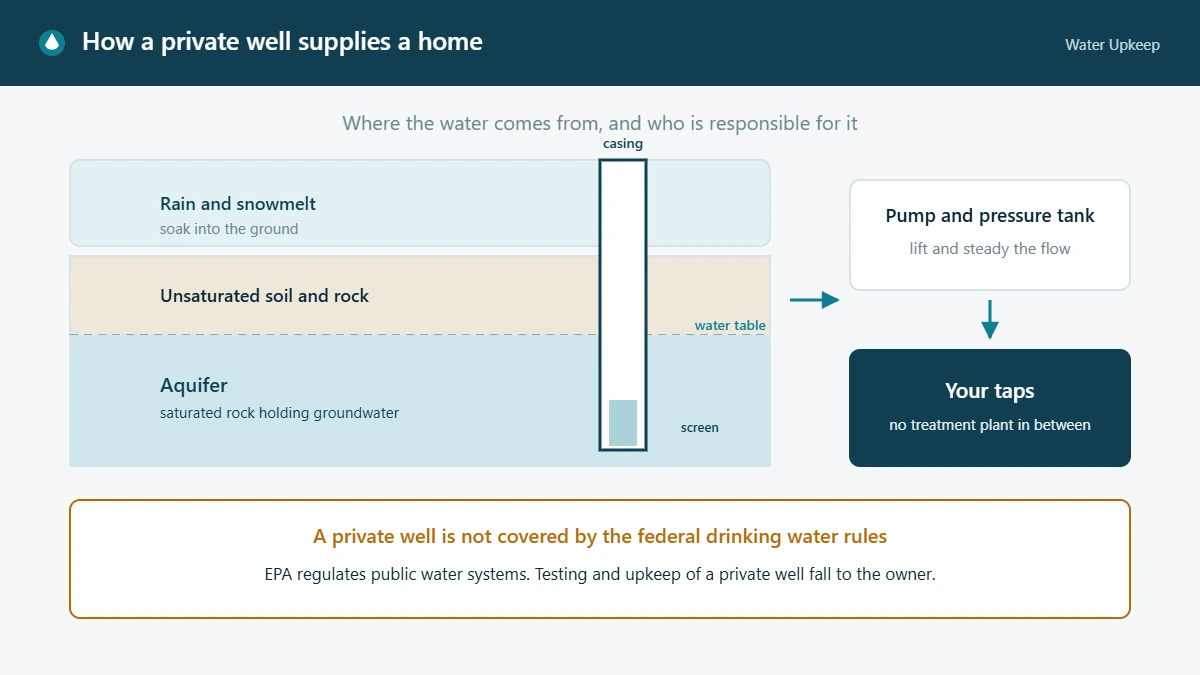
Well water is groundwater — rain and snowmelt that has soaked into the ground and collected in a water-bearing layer of rock or sediment called an aquifer — drawn up through a well by a pump. Around one in eight US households gets water this way rather than from a community water system. The single most important thing to understand about it is not geological but regulatory: if you are on a private well, nobody is checking your water but you.
Where well water comes from
Precipitation that does not run off into streams or evaporate soaks downward through soil and rock. Below a certain depth, the spaces between soil particles and the cracks in rock are completely filled with water. That saturated zone is the groundwater, and a body of rock or sediment that holds and transmits usable quantities of it is an aquifer.
A well is simply a hole that reaches into that saturated zone, with a pump to bring the water up. Because the water has travelled through soil and rock to get there, it carries the chemistry of whatever it passed through. That is why hardness, iron and sulfur vary so sharply between areas — and sometimes between neighbouring properties drawing from different depths.
Dug, driven and drilled wells
Wells differ in how they are built, and construction affects how well the water is protected from surface contamination.
| Type | How it is made | Protection from surface water |
|---|---|---|
| Dug | Excavated by hand or backhoe, relatively shallow and wide | Lowest — shallow depth leaves it most exposed |
| Driven | Pipe driven into soft ground, still comparatively shallow | Moderate, but limited by depth |
| Drilled | Bored by rig, can reach considerable depth, cased and grouted | Highest — depth plus proper casing and grouting |
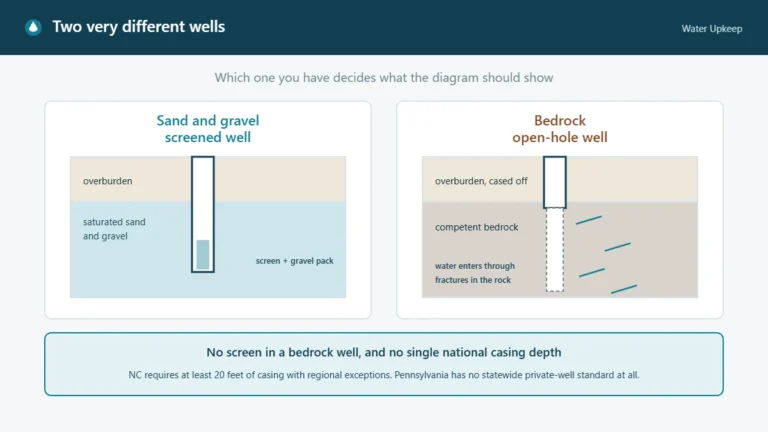
Casing is the lining that keeps the borehole open and seals it from the layers it passes through; grouting is the sealant around it. Together they are what stops surface water running straight down the outside of the well and into your supply.
Who regulates private wells?
Nobody, in the federal sense. The Safe Drinking Water Act and EPA’s national drinking water standards apply to public water systems. Private household wells fall outside that framework, and EPA does not regulate them. Responsibility for testing the water and deciding what to do about the results sits with the well owner.
Two conclusions are commonly drawn from that fact, and both are wrong. The first is that EPA somehow approves or monitors private wells — it does not, and no federal agency is sampling your water. The second is that being unregulated means the water is unsafe. It does not mean that either. Plenty of private wells produce excellent water. It means only that if something changes, no one else will notice on your behalf.
Some states and counties do impose their own requirements on well construction, siting and testing, particularly at the point of drilling or property sale. Those rules are local, and they vary considerably.
Why you do not receive an annual water quality report
Customers of community water systems receive an annual water quality report — often called a Consumer Confidence Report — each year by 1 July. It lists what was detected in the water over the past year and any violations.
Private well owners receive nothing of the kind, because there is no utility producing one. CDC is explicit that people using a private well are among those who will not get such a report. If you want to know what is in your water, a test is the only route to the answer.
What that means in practice
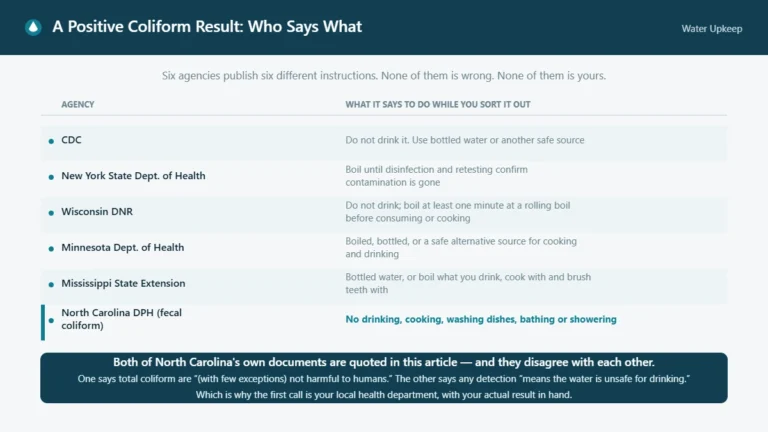
CDC’s guidance for private well owners is to test at least once a year, and to test whenever you notice a change in the water’s taste, colour or smell. A change is information: it means something in the well, the plumbing or the groundwater has shifted.
Testing is done through a state-certified laboratory, and your local or state health department is the usual starting point for finding one and for knowing which tests matter in your area. Our water testing guide covers the practicalities.
Protecting the area around your well
Because a well draws from the ground immediately around and beneath it, what happens at the surface nearby matters. CDC advises keeping potential contamination sources — septic systems, fuel tanks, livestock enclosures, chemical and fertiliser storage — at a distance from the wellhead, and keeping the area around it clear and properly graded so surface water drains away rather than pooling against the casing.
Specific separation distances are set by state and county code rather than nationally, and they differ. Treat any distance you read as general guidance and check what applies where you live before relying on it.
When to call a professional
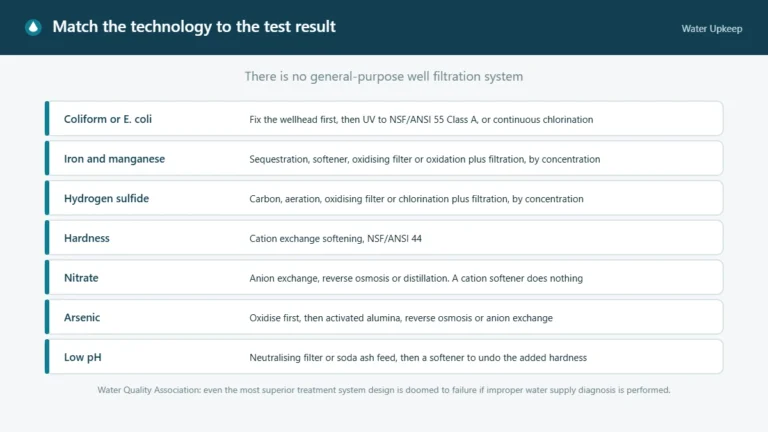
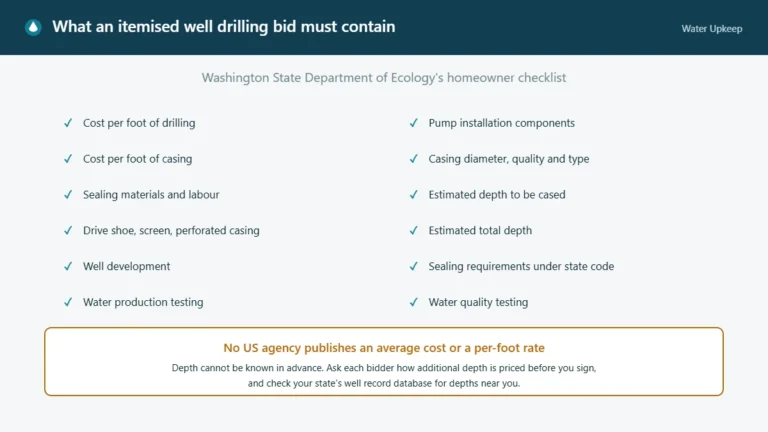
Well construction, casing and grouting, pump work and anything involving entering a well pit are jobs for a licensed well contractor. If a test comes back with something you do not understand, your state or local health department is the right first call — they know the regional issues and can point you at accredited laboratories. Our well water guide covers treatment options once you know what you are dealing with.
Sources and standards
- CDC — Guidelines for Testing Well Water. Owner responsibility, annual testing, and testing on a change in taste, colour or smell.
- US EPA — Private Drinking Water Wells. Private wells falling outside federal drinking water regulation.
- US Geological Survey — Groundwater Wells. Aquifers, well construction and how groundwater is drawn.
- CDC — How to Read Drinking Water Quality Reports. Who receives an annual report and who does not.
Water Upkeep does not sell or install water treatment equipment and does not conduct product testing. Every statement above is drawn from the published sources listed.
Last reviewed September 18, 2026.