Whole House Water Filter: When Point-of-Entry Is Actually Required
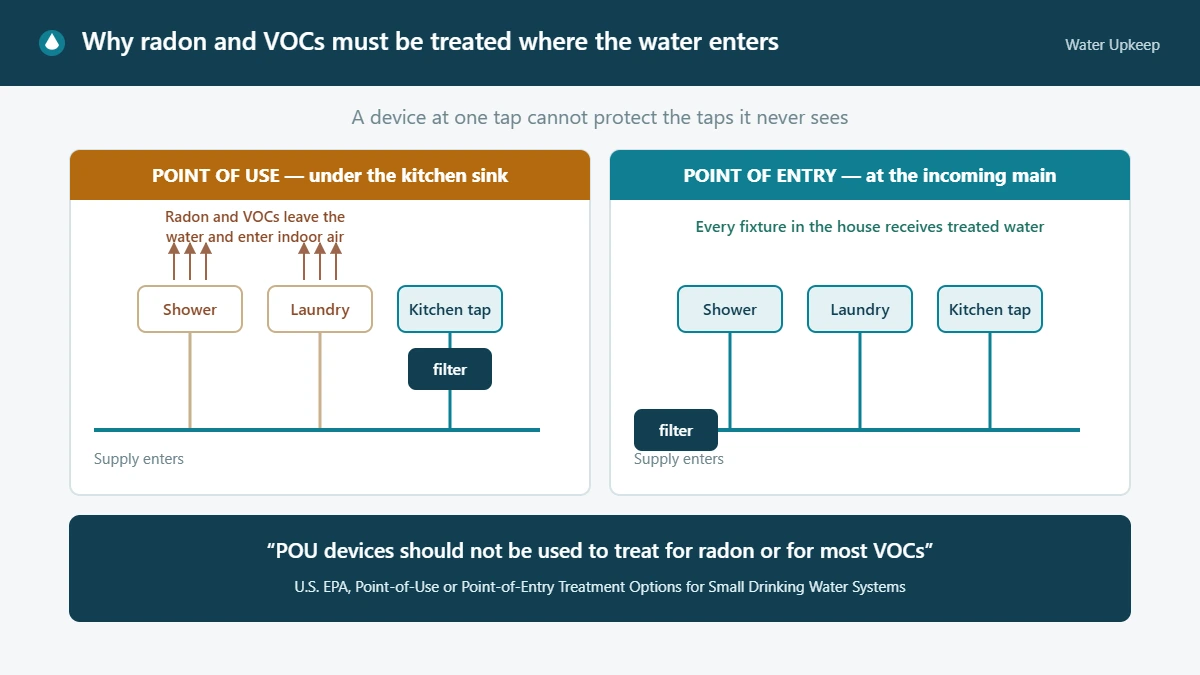
A whole house water filter treats every drop entering the building, and for most household water complaints that is a convenience rather than a necessity. There is one category where it is neither — where federal guidance says treating at a single tap is not good enough. EPA states that point-of-use devices “should not be used to treat for radon or for most VOCs,” because those devices “do not provide adequate protection against inhalation or contact exposure to these contaminants at untreated taps.”
That sentence is the strongest argument for a whole house system that exists on any government domain, and it applies to a narrow list. For hardness, nitrate and fluoride, a carbon-and-sediment whole house filter is simply the wrong device. Here is where the line sits.
What “whole house” means technically
EPA uses two terms. Point-of-entry (POE) devices “are typically installed to treat all water entering a single home, business, school, or facility.” Point-of-use (POU) devices “treat only the water intended for direct consumption (drinking and cooking), typically at a single tap or limited number of taps” — EPA’s focus being plumbed-in units with a separate faucet, usually under the kitchen sink. (EPA 815-R-06-010)
Virginia Cooperative Extension frames the same split practically: point-of-use means a “faucet-mounted filter or pour-through drip unit,” while point-of-entry is the “higher capacity” system treating water “before water enters the house.” Its own recommendation for POE carbon is narrow: extension staff “typically only recommend” it “for cases where volatile organic compounds, radon, or other impurities should be removed before water enters the house.”
The one case where point-of-entry is required, not preferred
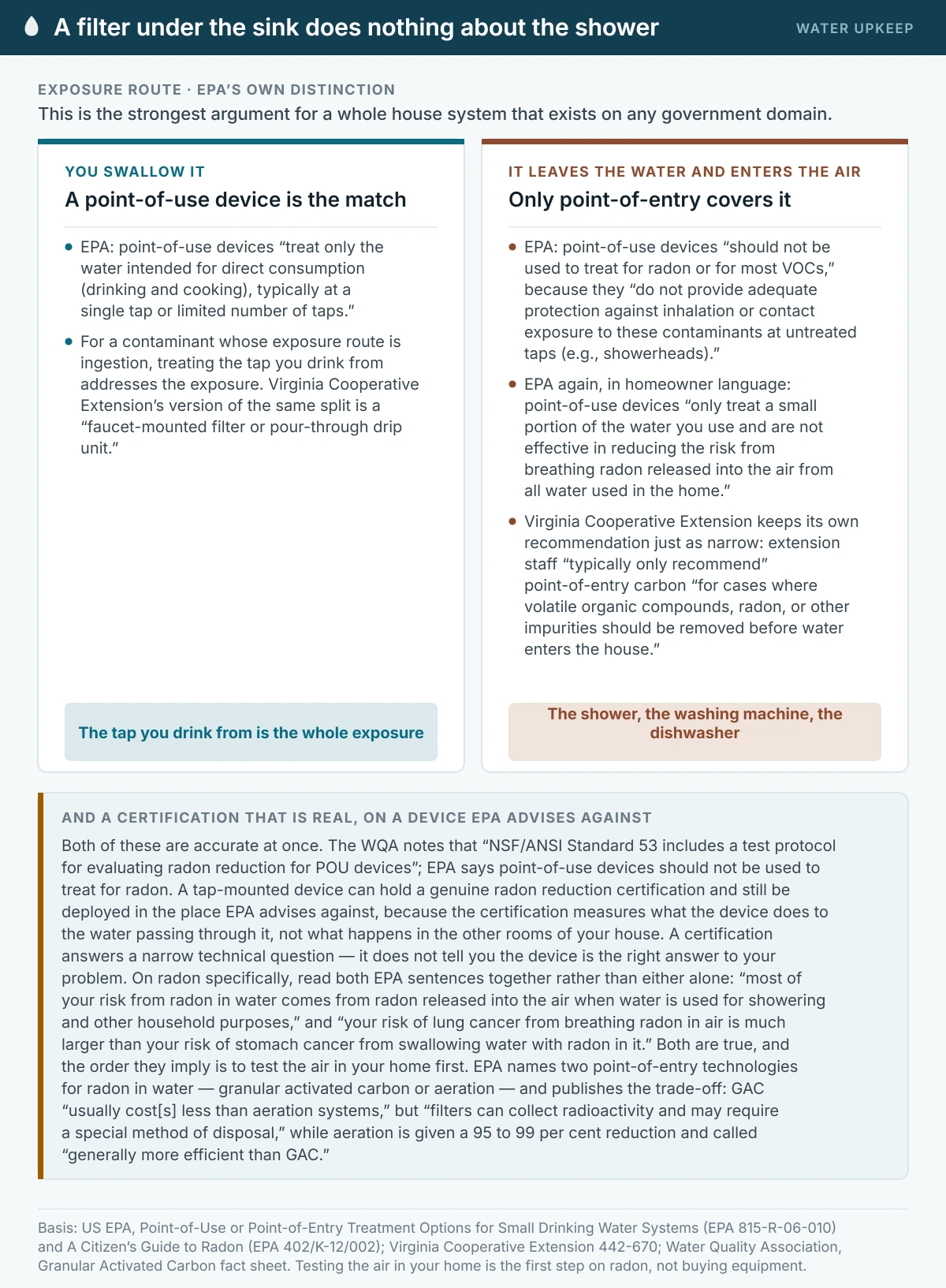
The reason is exposure route. Radon and most volatile organic compounds do not just get swallowed — they leave the water and enter the air. EPA explains that these substances “present an inhalation or contact exposure risk at untreated taps (e.g., showerheads).” A filter under the kitchen sink does nothing about the shower, the washing machine or the dishwasher.
EPA repeats the point in homeowner-facing language in A Citizen’s Guide to Radon: “Point-of-entry treatment can effectively remove radon from the water before it enters your home,” whereas point-of-use devices “only treat a small portion of the water you use and are not effective in reducing the risk from breathing radon released into the air from all water used in the home.”
Radon: read both of EPA’s statements together
Two EPA sentences get quoted separately, and each one misleads on its own. The first: “Most of your risk from radon in water comes from radon released into the air when water is used for showering and other household purposes.” The second: “Research has shown that your risk of lung cancer from breathing radon in air is much larger than your risk of stomach cancer from swallowing water with radon in it.”
Both are true and they are not in conflict. EPA is comparing the risk from radon in indoor air generally against the risk from drinking radon-bearing water. The practical order that follows: test the air in your home first, and if the water is the source of the radon, treat it at the point of entry, because that is where you stop it before it gets aerated indoors. Testing air radon is the first step, not buying equipment.
EPA names two point-of-entry technologies for radon in water: “granular activated carbon, or GAC, filters or aeration systems.” Its published trade-off is worth knowing before you choose: “while GAC filters usually cost less than aeration systems, filters can collect radioactivity and may require a special method of disposal.” EPA’s comparison gives aeration a 95 to 99 percent reduction and calls it “generally more efficient than GAC.” WQA adds a threshold: “at low influent radon activities (< 5000 pCi/L), EPA considers GAC to be a preferred treatment technology for POE, provided that the water being treated does not contain long-lived radionuclides.”
A certification tension worth understanding
Here is something a product page will not tell you. WQA notes that “NSF/ANSI Standard 53 includes a test protocol for evaluating radon reduction for POU devices.” Meanwhile EPA says point-of-use devices should not be used to treat for radon.
Both statements are accurate. A tap-mounted device can hold a genuine, legitimate certification for radon reduction under NSF/ANSI 53 — and still be deployed in the place EPA advises against, because the certification measures what the device does to the water passing through it, not what happens in the other rooms of your house. A certification answers a narrow technical question. It does not tell you the device is the right answer to your problem.
What whole-house carbon actually does
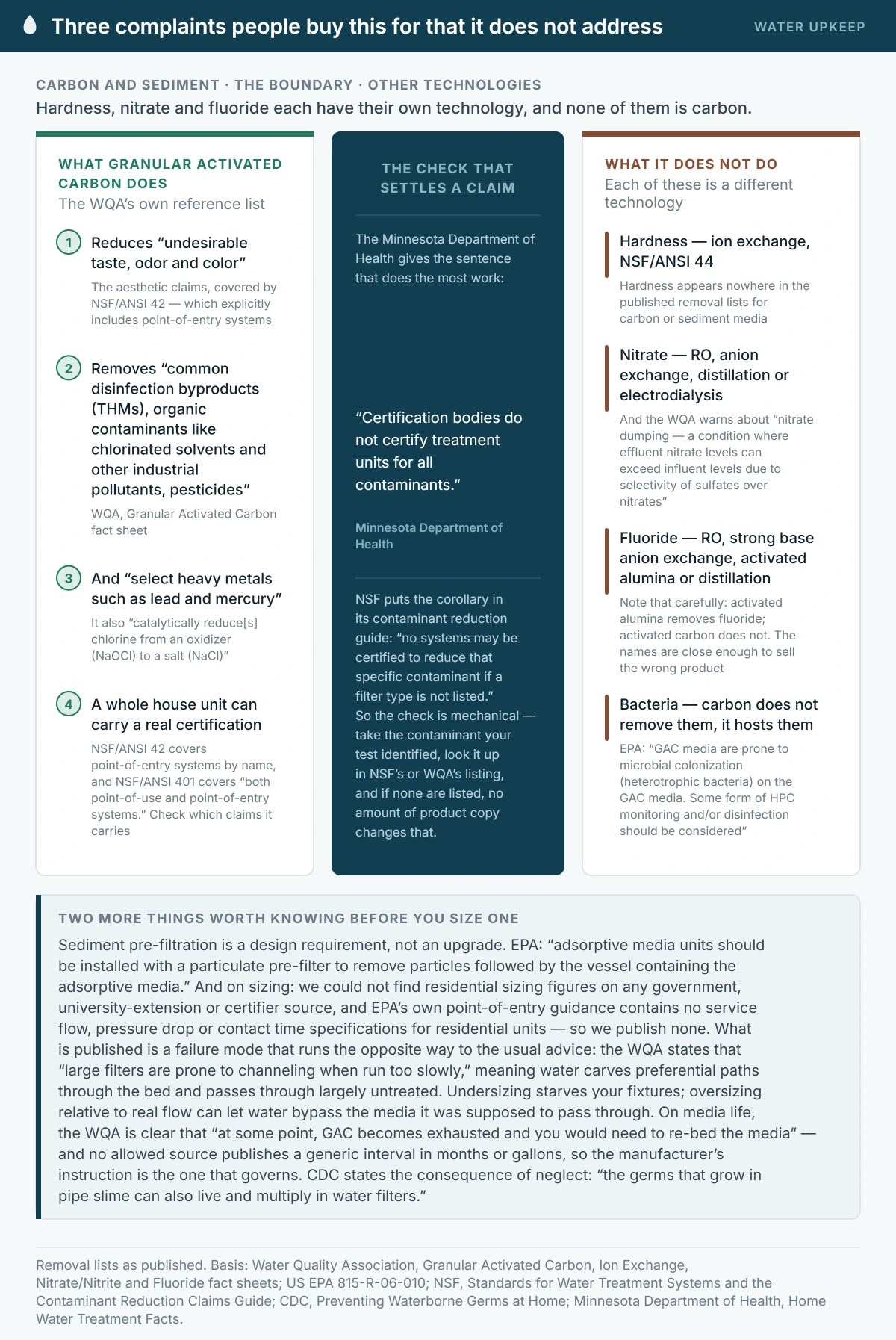
The Water Quality Association’s description of granular activated carbon is the reference list. GAC reduces “undesirable taste, odor and color” and removes “common disinfection byproducts (THMs), organic contaminants like chlorinated solvents and other industrial pollutants, pesticides, and select heavy metals such as lead and mercury.” It also “catalytically reduce[s] chlorine from an oxidizer (NaOCl) to a salt (NaCl).” (WQA, Granular Activated Carbon Fact Sheet)
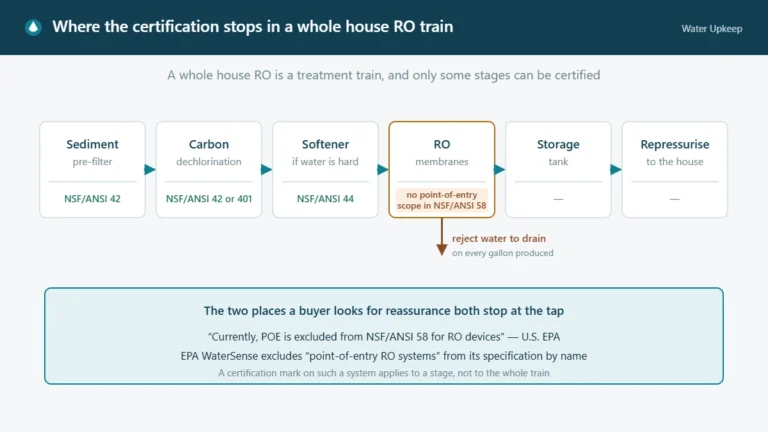
NSF/ANSI 42, the aesthetic-effects standard, explicitly covers “point-of-use (under the sink, water pitcher, etc.) or point-of-entry (whole house) treatment systems,” and NSF/ANSI 401 covers “both point-of-use and point-of-entry systems.” So a whole house unit can carry a real certification — you just have to check which claims it carries.
What it does not do
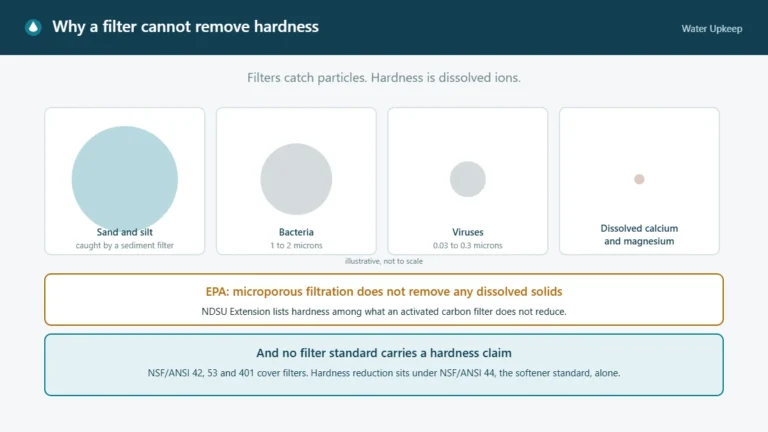
- Hardness. Hardness is removed by ion exchange, which WQA describes as handling “removal of hardness (as in softening)” with resin “regenerated with salt.” It is a separate certified category, NSF/ANSI 44. Hardness appears nowhere in the published removal lists for carbon or sediment media. If limescale is the complaint, see how to treat hard water.
- Nitrate. WQA’s published nitrate technologies are reverse osmosis with a thin film composite membrane, anion exchange, nitrate-selective anion resins, distillation and electrodialysis. Neither carbon nor sediment filtration appears on that list. WQA also warns about “nitrate dumping — a condition where effluent nitrate levels can exceed influent levels due to selectivity of sulfates over nitrates,” which is a reason to take anion exchange for nitrate seriously rather than casually.
- Fluoride. WQA lists reverse osmosis, strong base anion exchange, activated alumina adsorption media and distillation. Note that carefully: activated alumina removes fluoride; activated carbon does not. The names are close enough to sell the wrong product.
- Dissolved minerals generally. WQA notes that even softening, the adjacent technology, does “not reduce the total dissolved solids (TDS) or dissolved mineral content of water,” and that some dissolved organics escape carbon outright: “low MW alcohols such as methanol and ethanol for instance are very soluble in water and not removed by GAC.”
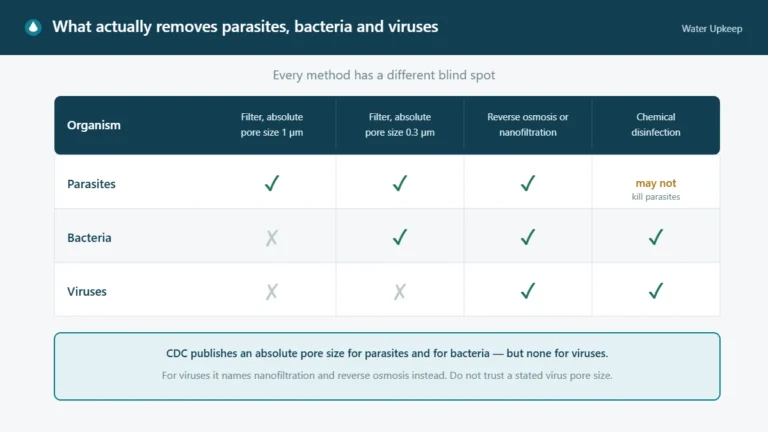
- Bacteria. Carbon does not remove them — it hosts them. EPA: “GAC media are prone to microbial colonization (heterotrophic bacteria) on the GAC media. Some form of HPC monitoring and/or disinfection should be considered.”
Sediment pre-filtration is a design requirement
EPA states it as a rule of installation rather than an upgrade: “adsorptive media units should be installed with a particulate pre-filter to remove particles followed by the vessel containing the adsorptive media.” Virginia Cooperative Extension defines what that pre-filter handles: “suspended particles found in water (e.g., sand, silt, clay, and oxidized iron and manganese).”
This matters most on a private supply, where particle loading is unpredictable. If that is your situation, our well water filtration guide covers the sequencing question in more depth.
Sizing: what nobody publishes, and the one thing that is published
Whole house filters are sold with confident flow-rate and pressure-drop numbers. We could not find residential sizing figures on any government, university-extension or certifier source, and EPA’s own point-of-entry guidance contains no service flow, pressure drop or contact time specifications for residential units. We are not going to publish a number that no authority stands behind.
What is published, and is genuinely useful, is a failure mode that runs the opposite direction to the usual advice: WQA states that “large filters are prone to channeling when run too slowly.” Channelling means water carves preferential paths through the media bed and passes through largely untreated. Undersizing starves your fixtures; oversizing relative to actual flow can let water bypass the media it was supposed to pass through. Both directions have a cost, which is a good reason to have the sizing done against your real household demand rather than against a catalogue category.
Media exhaust, and nobody publishes when
WQA is clear that carbon is consumable: “at some point, GAC becomes exhausted and you would need to re-bed the media.” What no allowed source publishes is a generic interval in months or gallons for a whole house system. CDC and state health departments defer to the manufacturer’s instructions, and so do we.
CDC does state the consequence of neglect: “The germs that grow in pipe slime can also live and multiply in water filters. This can happen when you do not properly maintain and replace the filters.” An unmaintained whole house filter is a large volume of wet media sitting upstream of everything you drink.
Four situations where a whole house filter is the wrong purchase
- During a boil-water advisory. CDC: “Boil your tap water even if you filter it. For example, still boil tap water if it has been through a home water filter or a pitcher that filters water.”
- For hardness, nitrate or fluoride. Each has its own technology, and none of them is carbon or sediment.
- For chemical or radiological contamination of the supply. CDC: “You cannot make water containing fuel, toxic chemicals, or radioactive materials safe by boiling or disinfecting it. Use bottled water or a different source of water instead.”
- Before you have tested. EPA: “Find out what is in your water and what you might want to remove before contacting potential dealers.” Start with water testing.
How to check a claim before you buy
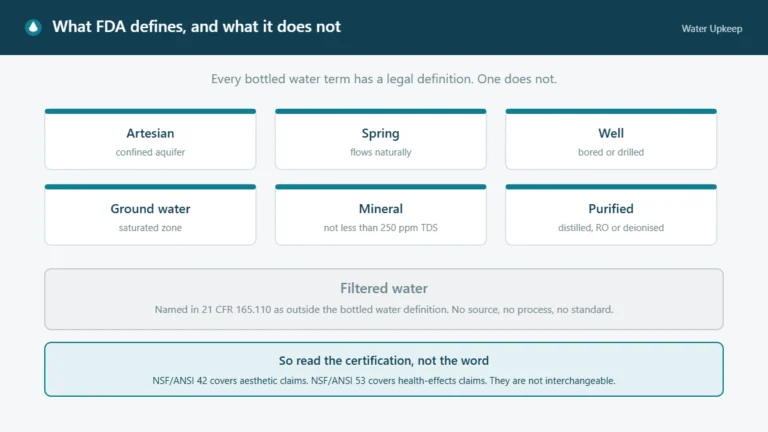
The Minnesota Department of Health gives the sentence that does the most work: certification bodies “do not certify treatment units for all contaminants.” NSF puts the corollary in its contaminant reduction guide: “remember that no systems may be certified to reduce that specific contaminant if a filter type is not listed.”
So the check is mechanical. Take the contaminant your test identified. Look it up in NSF’s certified products listing or WQA’s. If systems are listed for that claim, you have a shortlist. If none are, no amount of product copy changes that. And as NSF puts it: “read product labels and other literature carefully so that you understand the potential capabilities of the product as well as any operational limitations.”
A whole house filter is a good answer to a specific question. Make sure you have asked the question first — our overview of whole-house filtration covers where it fits alongside the rest of the equipment.
Sources
- U.S. EPA — Point-of-Use or Point-of-Entry Treatment Options for Small Drinking Water Systems (EPA 815-R-06-010); A Citizen’s Guide to Radon (EPA 402/K-12/002); Consumer’s Guide to Radon Reduction (EPA 402/K-10/005); Home Water Testing
- Water Quality Association — Granular Activated Carbon Fact Sheet; Ion Exchange Fact Sheet; Nitrate/Nitrite Fact Sheet; Fluoride Fact Sheet
- NSF — Standards for Water Treatment Systems; Contaminant Reduction Claims Guide; Product Label and Literature Claims
- U.S. CDC — Drinking Water Advisories: An Overview; How to Make Water Safe in an Emergency; Preventing Waterborne Germs at Home
- Minnesota Department of Health — Home Water Treatment Facts
- Virginia Cooperative Extension, Virginia Tech — Household Water Treatment, publication 442-670
Last reviewed September 9, 2026.